B2. Un monde poreux qui se croit étanche - 水漏れがないと思い込んでいる、穴だらけの世界 - A porous world that thinks it’s watertight
popularité : 19%

| Texte en français | English Text | 日本語のテキスト |
YouTube video
Français
Vous appréciez la présence de notre site sur le Web : vous pouvez faire un don à la communauté dans laquelle je vis (cliquer ici pour voir comment procéder)
Le plan [1]
- 1. Une analogie mathématique
- 2. Il y a autre chose
- 3. L’irruption d’autre chose
- 4. La révélation du péché
1§ Nous vivons dans un monde désenchanté où l’on croit pouvoir expliquer le monde à partir de lui et lui seul [2]. Une tendance lourde de notre époque considère qu’il n’y a rien en deçà ou au-delà de cet univers, et que, même s’il y avait quelque chose, nous ne pourrions pas la percevoir, donc inutile de poser une hypothèse au mieux inutile, au pire dangereuse.
1. Une analogie mathématique
2§ De fait, nous sommes comme des êtres dans un monde à deux dimensions : ils peuvent élaborer les notions spatiales de droite et de gauche, de devant et de derrière, mais comment pourraient-ils avoir l’idée du haut et du bas ?
3§ Si Dieu est de l’ordre de l’incréé, en dehors du temps et de l’espace, comment pourrions-nous échanger avec lui, nous qui sommes des créatures constitutivement liées à un univers spatio-temporel ? « On ne saute pas hors de son ombre » dit un proverbe espagnol ou arabe. Ressortant de l’ordre du créé, nous ne pouvons pas en sortir et donc Dieu nous est inaccessible.
4§ Le raisonnement ne tient cependant pas si, dans le monde de surface vu précédemment, un être tri-dimensionnel apparaissait, révélant l’existence de la dimension verticale. Il s’agirait alors pour les êtres bi-dimensionnels de lui faire confiance et de le suivre.
5§ Dans cette analogie mathématique, l’être tridimensionnel représente Dieu qui s’incarne en Jésus. En lui, Dieu prend les chemins de l’homme pour que l’homme prenne le chemin vers Dieu.
6§ La tâche de cet être serait facilitée si les autres êtres avaient l’intuition que leur monde à deux dimensions n’épuisait pas toute la réalité. Sa révélation viendrait alors sur un terrain préparé.
7§ Il en va ainsi pour l’être humain. Je suis persuadé que l’être humain constitutivement ne se satisfait pas de ce qu’il a sous les yeux, parce qu’il porte en lui un désir d’absolu et qu’il ne sera jamais en repos tant qu’il n’aura pas trouvé cet absolu dont il a l’intuition.
2. Il y a autre chose
8§ L’homme a en lui une petite voix qui lui souffle : « Il n’est pas possible que le monde se réduise à ce que j’en perçois, il n’est pas possible que tout s’arrête après la mort. Il n’est pas possible que la méchanceté et l’injustice ne reçoivent pas leur rétribution, il n’est pas possible que les actes de bonté et de justice disparaissent dans l’oubli. Il doit y avoir quelque chose de plus grand dans lequel tout ce que nous vivons s’inscrit et prend sens, un sens qui nous dépasse infiniment mais dans lequel nous trouverons la paix et le bonheur ».
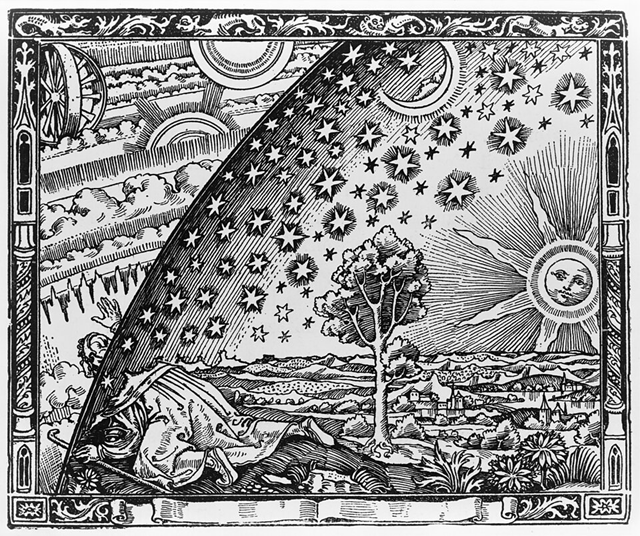
9§ Je trouve une illustration de cette inquiétude fondamentale dans La gravure de Flammarion, où l’on voit un homme passer la tête au delà de la voute céleste pour voir ce qu’il y a au-delà : l’être humain est cet être qui ne peut pas rester en place tant qu’il ne sait pas ce qu’il y a au-delà de cette montagne, au-delà de cet océan – les Polynésiens qui se sont aventurés sur la mer ne savaient pas qu’il y avait l’Australie au-delà de l’horizon -, au-delà de la voûte céleste à l’instar du pèlerin de la gravure. Et son inquiétude n’est pas seulement spatiale, elle est aussi temporelle : « Y-a- il quelque chose après la mort ? » se demandait déjà l’homme du paléolithique, et il y répondait par l’affirmative comme le démontrent les vestiges funéraires qu’il a laissés derrière lui.
10§ Dans la foi, nous voyons dans cette inquiétude le sceau de Dieu qui m’a créé à son image et ressemblance. Comme image de Dieu, je suis en quête de la ressemblance toujours plus grande avec mon Créateur.
11§ L’être humain est cette créature unique en ce qu’elle lève les yeux vers le ciel sans savoir ce qu’elle y cherche, mais avec la certitude qu’il s’y trouve quelque chose.
fecisti nos ad te et inquietum est cor nostrum, donec requiescat in te.
« Tu nous as fait pour toi, et notre cœur est sans repos tant qu’il ne repose en toi »
Augustin, les Confessions, I,1,1 [3]
12§ Et je suis convaincu que refuser cette aspiration, c’est s’exposer à perdre l’essence même de notre humanité. Augustin a éprouvé cette aspiration au plus haut point, et il a eu le bonheur de la voir se réaliser dans sa vie, comme nous allons le voir maintenant.
3. L’irruption d’autre chose
13§ Augustin (354-430) a fait l’expérience d’une brèche survenue de nulle part dans un monde pourtant hermétiquement clos [4].
14§ Cela a d’abord commencé par la brèche opérée dans son intelligence : Augustin ne croyait pas qu’il pouvait y avoir une réalité en dehors de ce monde, il était enfermé dans une conception du monde « horizontale », jusqu’à ce, sans qu’il n’y puisse rien, il a été saisi par une réalité au-delà de ce monde, Dieu, et cela a renversé complètement ses certitudes : avant, il doutait de l’existence de Dieu et il était par contre certain de sa propre existence, après il était plus sûr de l’existence de Dieu que de la sienne propre : « je douterais plus facilement de mon existence que de l’existence de Dieu », dira-t-il en substance dans ses Confessions [5].
15§ Augustin a fait ensuite l’expérience d’une brèche dans son affectivité : lui qui se sentait incapable de la continence sexuelle, il a expérimenté la libération de son attachement sensuel grâce à la lecture d’un passage de saint Paul [6]
16§ L’expérience d’Augustin a été double :
- il a fait l’expérience douloureuse de l’incapacité de son affectivité et de son intelligence à sortir d’elles-mêmes par leurs seules forces ;
- il a découvert par contre qu’elles étaient « poreuses » à quelque chose venu d’ailleurs, de vraiment ailleurs, qui les transforme et les fait accéder à une autre dimension.
17§ Augustin a fait l’expérience de l’intervention d’une altérité radicale qui peut survenir à tout moment et n’importe où, y compris au plus intime du cœur, et tout transformer : cette action s’appelle en théologie la grâce.
4. La révélation du péché
18§ C’est seulement par la grâce de Dieu que l’être humain sort de sa condition peccamineuse : pour Augustin, la condition humaine est en effet marquée par un « péché originel », une macula, une tache en latin, transmise héréditairement.
19§ Augustin prend l’exemple du nourrisson : alors qu’il est allaité par sa nourrice, il regarde déjà avec méchanceté le nourrisson qui tête l’autre sein [7] : à peine né, le bébé pèche déjà.
20§ Augustin marche sur les brisées de saint Paul pour qui la volonté humaine est incapable de s’attacher au bien, travaillée qu’elle est par l’attrait du mal :
Car je sais qu’en moi - je veux dire dans ma chair - le bien n’habite pas : vouloir le bien est à ma portée, mais non pas l’accomplir, puisque le bien que je veux, je ne le fais pas et le mal que je ne veux pas, je le fais. Or, si ce que je ne veux pas, je le fais, ce n’est pas moi qui agis, mais le péché qui habite en moi. Moi qui veux faire le bien, je constate donc cette loi : c’est le mal qui est à ma portée. Car je prends plaisir à la loi de Dieu, en tant qu’homme intérieur, mais, dans mes membres, je découvre une autre loi qui combat contre la loi que ratifie mon intelligence ; elle fait de moi le prisonnier de la loi du péché qui est dans mes membres. Malheureux homme que je suis ! Qui me délivrera de ce corps qui appartient à la mort ? Grâce soit rendue à Dieu par Jésus Christ, notre Seigneur ! Me voilà donc à la fois assujetti par l’intelligence à la loi de Dieu et par la chair à la loi du péché.
Romains 7,18-25
21§ Dans la condition humaine actuelle, je ne suis plus libre de poser des actes entièrement bons, des actes qui puissent « plaire » entièrement à Dieu : je suis devenu esclave du péché, non en tant que tout ce que je fais est mal, mais en tant que tout ce que je fais est parasité par une volonté faussée et une intelligence erronée.
22§ Cela dit, je ne crois pas juste de dire que Paul et Augustin étaient pessimistes. À mon avis, Paul et Augustin ont bâti leur doctrine à partir de cette expérience d’irruption de la grâce dans leur vie, grâce qui les a libérés de leurs enfermements et leur a ouvert un horizon d’amour infini.
23§ Ils y ont répondu dans un raz-de-marée de gratitude et d’amour d’autant plus puissant qu’ils ont pressenti la puissance inconcevable de Dieu et parallèlement leur impuissance radicale : la grâce nous est donnée alors que nous ne la méritons pas, plus même, alors que nous ne pouvons même pas la mériter après la faute originelle d’Adam et Ève [8].
24§ Cette expérience les émerveille tellement que, par contrecoup, ils minorent le long travail de préparation qui a précédé l’évènement de grâce. Ainsi, selon moi, Dieu s’est servi des recherches d’Augustin auprès des manichéens et des néoplatoniciens pour l’amener à ce moment de rupture.
Merci de votre attention
© frère Franck Guyen o.p., février 2026
日本語
当ウェブサイトがウェブ上で運営されていることをご評価いただける場合は、私が暮らす地域社会への寄付をご検討ください([寄付方法はこちら→https://dominicainslille.fr/?page_id=84])
計画 [9]
- 1. 数学的な類推
- 2. そこには「何か別のもの」がある
- 3. 「何か別のもの」の突如としての現れ
- 4. 罪の啓示
1§ 私たちは、世界そのものだけを根拠として、それ以外の何ものにも頼らずに世界を説明できると人々が信じている、魔法が失われた世界に生きています [10] 現代の主流となる傾向として、この宇宙の内にも外にも何もないという考えがあり、たとえ何かがあったとしても、私たちはそれを知覚することはできないとされています。したがって、せいぜい無用であり、最悪の場合は危険でさえあるような仮説を立てる意味はないのです。
1. 数学的な類推
2§ 実際、私たちは二次元の世界に生きる存在のようなものです。彼らは「右」や「左」、「前」や「後ろ」といった空間的概念は理解できますが、「上」や「下」をどのようにして想像できるでしょうか?
3§ もし神が、時間と空間の外にある「非被造物」の領域に属する存在であるならば、時空的な宇宙に本質的に縛られている被造物である私たちが、どうして神とコミュニケーションをとることができるでしょうか。「人は自分の影から飛び出すことはできない」と、スペインやアラビアの諺に言われています。私たちは被造物の秩序に属しているため、その外へ踏み出すことはできず、したがって神には到達できないのです。
4§ しかし、先に考察した二次元の世界に、三次元の存在が現れ、垂直次元の存在を明らかにしたとしたら、この推論は成り立ちません。その場合、二次元の存在たちは、その存在を信頼し、それに従わなければならないでしょう。
5§ この数学的な比喩において、三次元の存在は、イエスに受肉された神を表しています。神は、人類が神へと向かう道を歩めるように、イエスにおいて人類の道を歩まれるのです。
6§ もし他の存在たちが、自分たちの二次元の世界が現実のすべてを網羅しているわけではないという直感を持っていれば、この存在の使命はより容易になるでしょう。そうすれば、その啓示は肥沃な土壌に受け止められることになるでしょう。
7§ 人間についても同様です。私は、人間はその本質上、目の前にあるものだけでは満足しないものと確信しています。なぜなら、人間は自らの内に絶対者への渇望を抱いており、直感的に感じ取っているこの絶対者を発見するまでは、決して安らぎを見出せないからです。
2. 他にも何かがある
8§ 人間には、心の中に「世界が自分の知覚する範囲に限定されているはずがない。死の後にすべてが終わるはずがない。悪や不正が罰せられないはずがない。親切や正義の行いが忘れ去られるはずがない。私たちが経験するすべてのものに居場所と意味を見いだせる、より偉大な何かが必ず存在するはずです――それは私たちを無限に超越した意味でありながら、その中で私たちは平安と幸福を見いだすことができるのです。」
9§ 私は、フラマリオンによるこの版画の中に、この根本的な不安の象徴を見出します。そこには、天のドームの向こうに何があるかを見ようと、頭を突き出している男の姿が描かれています: 人間とは、あの山の向こう、あの海の向こう――海へ冒険に出たポリネシアの人々は、地平線の彼方にオーストラリアがあることを知らなかった――天のドームの向こうに何があるかを知るまで、安らぐことのできない生き物なのです。まさに、その版画に描かれた巡礼者のように。そして、その落ち着きのなさは単に空間的なものにとどまらず、時間的なものでもあります。「死の後に何かはあるのか?」――旧石器時代の人々はすでにそう自問しており、彼らが残した埋葬遺物からも明らかなように、肯定的な答えを出していたのです。
10§ 信仰の観点から言えば、私たちはこの関心の中に、私を神の像と似姿として創造してくださった神の御業の痕跡を見出すのです。神の像として、私は創造主へのより一層の似姿を求めています。
11§ 人間は、そこで何を探しているのかを知らずに天を仰ぎ見ながらも、そこに何かが見つかるという確信を持っているという点で、唯一無二の被造物です。fecisti nos ad te et inquietum est cor nostrum, donec requiescat in te.
「あなたは私たちを御自身のために造られました。私たちの心は、あなたに安らぐまで、安らぎを得ることができません」
アウグスティヌス、『告白録』、I,1,1 [11]12§ そして私は、この渇望を拒むことは、私たちの人間性そのものを失う危険を冒すことになると確信しています。アウグスティヌスはこの渇望を極限まで体験し、これから見ていくように、その生涯においてそれが成就されるのを目にする幸運に恵まれました。
3. 何か別のものの突如とした侵入
13§ アウグスティヌス(354–430)は、それまでは完全に密閉されていた世界に、どこからともなく現れた亀裂を経験しました [12]で、この出来事を語っています。
14§ それはまず第一に、彼の理解における裂け目から始まりました: アウグスティヌスは、この世界の外に現実が存在し得るとは信じていませんでした。彼は「水平的な」世界観に閉じ込められていましたが、自らの努力とは無関係に、この世界を超えた現実――すなわち神――に捉えられたことで、その確信は完全に覆されてしまいました。それまでは、自身の存在を確信しつつも神の存在を疑っていましたが、その後は、自身の存在よりも神の存在をより確信するようになったのです: 「『私は、神の存在よりも、むしろ自分の存在の方を疑うだろう』」と、彼は『i』『告白録』の中で、要約すればこのように述べています [13] 。
15§ その後、アウグスティヌスは感情面において変化を経験しました。以前は性的自制が不可能だと感じていましたが、聖パウロの文章を読むことで、官能的な執着から解放されたのです [ [聖アウグスティヌスの 『告白録』を参照、 第8巻、第12章 ]]
16§ アウグスティヌスの体験には二つの側面がありました: - 彼は、自らの感情や知性が、それ自体の力だけでは自らを超越することはできないという痛ましい気づきを得ました;
- 一方で、それらが「他所」――真に「他所」――から来る何かに「浸透されやすい」ものであることを発見しました。その何かは、それらを変容させ、別の次元へと入ることを可能にするのです。
17§ アウグスティヌスは、いつでもどこでも、心の最も奥底においても起こり得る、あらゆるものを変容させる根本的な他者性の介入を体験しました。神学において、この働きは「恵み」と呼ばれています。
4. 罪の啓示
18§ 人間が罪深い状態から救われるのは、神の恵みによるのみです。アウグスティヌスにとって、人間の状態はまさに「原罪」、すなわちmacula――ラテン語で「汚れ」を意味する――によって特徴づけられており、それは世代から世代へと受け継がれていくものです。
19§ アウグスティヌスは乳児の例を挙げています。乳母に乳を飲まされている最中、その子はすでに、もう一方の乳房から乳を吸っている乳児を悪意に満ちた眼差しで見つめているのです [14]:生まれたばかりの赤ん坊は、すでに罪を犯しているのです。
20§ アウグスティヌスは、聖パウロの足跡をたどっています。聖パウロによれば、人間の意志は、悪の魅力に引き裂かれているため、善に固執することができないのです:「私は、自分の中――すなわち、私の肉の中――には善が宿っていないことを知っています。善を望むことは私の力に及ぶのですが、それを実行することはできません。なぜなら、私が望む善は行わず、望まない悪を行ってしまうからです。さて、もし私が望まないことを行うならば、それを行うのは私ではなく、私の内に宿る罪なのです。」 ですから、善を行いたいと願う私は、次のような法則に気づきます。すなわち、私の力にあるのは悪なのです。私は心の奥底で神の律法を喜びとしていますが、私の肢体の中には、私の心の律法と対立する別の律法があり、それが私を、私の肢体にある罪の律法に捕らえて離さないのです。なんと惨めな人間でしょう! 誰が、この死の体から私を救い出してくれるのでしょうか?私たちの主イエス・キリストを通して、神に感謝いたします! こうして私は、心では神の律法に従い、肉では罪の律法に従うという状態にあるのです。
ローマ人への手紙 7:18–2521§ 現在の人間の状態において、私はもはや、完全に善なる行い、すなわち神を完全に「喜ばせる」ような行いを自由に行うことはできません。私は罪の奴隷となってしまいました。それは、私の行うことがすべて悪であるという意味ではなく、私の行うことがすべて、歪んだ意志と誤った心によって損なわれているという意味です。
22§ とはいえ、パウロやアウグスティヌスを悲観主義者だと言うのは公平ではないと思います。私の見解では、パウロとアウグスティヌスは、自分たちの生活に突如として押し寄せた恵みの体験――彼らを束縛から解き放ち、無限の愛の地平を開いてくれた恵み――の上に、自らの教義を築き上げたのです。
23§ 彼らはこれに対し、感謝と愛の津波のような反応を示しました。その反応は、神の計り知れない力に対する認識と、同時に、自分たちの根本的な無力さに対する認識によって、さらに力強いものとなりました。恵みは、私たちがそれに値しないにもかかわらず与えられるのです。それどころか、アダムとエバの原罪の後では、私たちがそれに値するはずがないにもかかわらず、なおさら与えられるのです [15]。
24§ この体験は彼らを深い驚嘆で満たし、その結果、この恵みの出来事に先立つ長い準備の過程が軽視されてしまいました。したがって、私の見解では、神はアウグスティヌスがマニ教徒や新プラトン主義者たちとの間で学んだことを用いて、彼をこの「断絶」の瞬間へと導かれたのです。
ご清聴ありがとうございました
© フランク・ギエン修道士 O.P.、2026年2月
English
If you appreciate our website’s presence on the web, you can make a donation to the community in which I live (click here to find out how)
The plan [16]
- 1. A mathematical analogy
- 2. There is something else
- 3. The irruption of something else
- 4. The revelation of sin
1§ We live in a disenchanted world where people believe they can explain the world on the basis of the world itself and nothing else [17]. A prevailing trend of our time holds that there is nothing either within or beyond this universe, and that, even if there were something, we would be unable to perceive it ; therefore, there is no point in positing a hypothesis that is, at best, useless and, at worst, dangerous.
1. A mathematical analogy
2§ In fact, we are like beings in a two-dimensional world : they can grasp the spatial concepts of right and left, front and back, but how could they possibly conceive of up and down ?
3§ If God belongs to the realm of the uncreated, outside of time and space, how could we possibly communicate with him, we who are creatures intrinsically bound to a spatio-temporal universe ? ‘One cannot leap out of one’s own shadow,’ says a Spanish or Arabic proverb. As we belong to the created order, we cannot step outside it, and so God is inaccessible to us.
4§ However, this line of reasoning does not hold if, in the two-dimensional world considered earlier, a three-dimensional being were to appear, revealing the existence of the vertical dimension. The two-dimensional beings would then have to trust this being and follow it.
5§ In this mathematical analogy, the three-dimensional being represents God incarnate in Jesus. In him, God takes the path of humankind so that humankind may take the path towards God.
6§ This being’s task would be made easier if the other beings had the intuition that their two-dimensional world did not encompass the whole of reality. His revelation would then fall on fertile ground.
7§ The same is true of human beings. I am convinced that human beings, by their very nature, are not satisfied with what lies before their eyes, because they harbour within themselves a longing for the absolute and will never find rest until they have discovered this absolute which they intuitively sense.
2. There is something else
8§ Human beings have a little voice within them that whispers : ‘It is not possible that the world is reduced to what I perceive of it ; it is not possible that everything ends after death. It cannot be that wickedness and injustice go unpunished ; it cannot be that acts of kindness and justice fade into oblivion. There must be something greater in which everything we experience finds its place and meaning—a meaning that infinitely transcends us, yet in which we shall find peace and happiness.”
9§ I find an illustration of this fundamental anxiety in Flammarion’s engraving, in which a man is seen sticking his head beyond the celestial vault to see what lies beyond : human beings are creatures who cannot rest until they know what lies beyond that mountain, beyond that ocean – the Polynesians who ventured out to sea did not know that Australia lay beyond the horizon – beyond the celestial vault, just like the pilgrim in the engraving. And his restlessness is not merely spatial, it is also temporal : ‘Is there anything after death ?’ the Palaeolithic man was already asking himself, and he answered in the affirmative, as demonstrated by the funerary remains he left behind.
10§ In faith, we see in this concern the mark of God, who created me in his image and likeness. As the image of God, I am seeking ever greater likeness to my Creator.
11§ Human beings are unique creatures in that they lift their eyes to the heavens without knowing what they are seeking there, yet with the certainty that something is to be found there.fecisti nos ad te et inquietum est cor nostrum, donec requiescat in te.
‘You have made us for Yourself, and our hearts are restless until they rest in You’
Augustine, the Confessions, I,1,1 [18]12§ And I am convinced that to reject this longing is to risk losing the very essence of our humanity. Augustine experienced this longing to the fullest extent, and he had the good fortune to see it fulfilled in his life, as we shall now see.
3. The irruption of something else
13§ Augustine (354–430) experienced a breach that appeared out of nowhere in a world that was otherwise hermetically sealed [19].
14§ It began, first of all, with a breach in his understanding : Augustine did not believe that there could be any reality outside this world ; he was confined to a ‘horizontal’ conception of the world, until, through no effort of his own, he was seized by a reality beyond this world—God—and this completely overturned his certainties : previously, he had doubted the existence of God whilst being certain of his own existence ; afterwards, he was more certain of God’s existence than of his own : ‘ ‘I would more readily doubt my own existence than the existence of God’”, he would say, in essence, in his Confessions [20] .
15§ Augustine then experienced a shift in his emotional life : having previously felt incapable of sexual self-restraint, he found liberation from his sensual attachments through reading a passage from Saint Paul [ [See St Augustine’s Confessions, Book 8, Chapter 12 ]]
16§ Augustine’s experience was twofold : - he underwent the painful realisation that his emotions and his intellect were incapable of transcending themselves by their own power alone ;
- on the other hand, he discovered that they were ‘permeable’ to something coming from elsewhere—truly elsewhere—which transforms them and enables them to enter another dimension.
17§ Augustine experienced the intervention of a radical otherness that can occur at any time and anywhere, including in the innermost depths of the heart, and transform everything : in theology, this action is called grace.
4. The revelation of sin
18§ It is only through God’s grace that human beings are delivered from their sinful condition : for Augustine, the human condition is indeed marked by ‘original sin’, a macula—a stain in Latin—which is passed down through the generations.
19§ Augustine takes the example of the infant : whilst being breastfed by his wet nurse, he already looks with malice at the infant suckling the other breast [21] : barely born, the baby is already sinning.
20§ Augustine follows in the footsteps of Saint Paul, for whom the human will is incapable of clinging to the good, as it is torn by the allure of evil :For I know that in me – that is to say, in my flesh – good does not dwell : to will the good is within my power, but not to do it, since the good that I will, I do not do, and the evil that I do not will, I do. Now, if I do what I do not want to do, it is not I who do it, but the sin that dwells within me. I, who wish to do good, therefore observe this law : it is evil that is within my power. For I delight in the law of God, in my inner being ; but I find in my members another law at war with the law of my mind ; and it holds me captive to the law of sin that is in my members. Wretched man that I am ! Who will deliver me from this body of death ? Thanks be to God through Jesus Christ our Lord ! So here I am, subject both by my mind to the law of God and by my flesh to the law of sin.
Romans 7:18–2521§ In the present human condition, I am no longer free to perform acts that are entirely good, acts that might ‘please’ God entirely : I have become a slave to sin, not in the sense that everything I do is evil, but in the sense that everything I do is marred by a distorted will and a misguided mind.
22§ That said, I do not think it is fair to say that Paul and Augustine were pessimists. In my view, Paul and Augustine built their doctrine upon this experience of grace bursting into their lives—a grace that freed them from their confinement and opened up a horizon of infinite love for them.
23§ They responded to this with a tidal wave of gratitude and love, made all the more powerful by their sense of God’s inconceivable power and, at the same time, their own radical powerlessness : grace is given to us even though we do not deserve it ; indeed, even more so, even though we cannot possibly deserve it following Adam and Eve’s original sin [22].
24§ This experience filled them with such wonder that, as a consequence, they downplayed the long process of preparation that had preceded this event of grace. Thus, in my view, God made use of Augustine’s studies amongst the Manichaeans and Neoplatonists to lead him to this moment of rupture.
Thank you for your attention
© Brother Franck Guyen O.P., February 2026
[1] Cet article fait suite à deux rencontres de la formation continue des Fraternités laïques dominicaines des Hauts-de-France. Il reprend les conclusions suivantes de ces rencontres :
[2] Le savant français Laplace (1749-1827) aurait répondu à Napoléon qui lui reprochait de ne pas parler de Dieu dans son Traité de Mécanique céleste : « Sire, répondit Laplace, je n’avais pas besoin de cette hypothèse ».
[4] Il le raconte au livre 7 chapitre 10 des Confessions
[6] Voir Les Confessions de saint Augustin, livre 8 chapitre 12
[8] Le récit de la faute originelle dans la Bible peut s’entendre comme une façon de rendre compte d’un monde faussé, d’un monde qui « ne tourne pas rond ».
[9] この記事は、オー=ド=フランス・ドミニコ会信徒友愛会による2回の継続教育会議を受けて執筆されたものです。これらの会議から得られた以下の結論を要約しています:
[10] フランスの科学者ラプラス(1749–1827)は、自身の『天体力学論』において神に言及していないと非難したナポレオンに対し、次のように答えたと伝えられています: 「陛下」とラプラスは答えました。「私には、その仮説は必要ありませんでした」。
[11] [ラテン語版はこちら→https://faculty.georgetown.edu/jod/latinconf/1.html]
[13] 『アウグスティヌスにおける心の転換』を参照→https://www.esperer-isshoni.fr/spip.php?article173#c3]
[15] 原罪に関する聖書の記述は、歪んだ世界、すなわち「あるべき姿ではない」世界を説明する一つの方法として理解することができます。
[16] This article follows on from two continuing education meetings of the Dominican Lay Fraternities of Hauts-de-France. It summarises the following conclusions from these meetings :
[17] The French scientist Laplace (1749–1827) is said to have replied to Napoleon, who reproached him for not mentioning God in his Treatise on Celestial Mechanics : ‘Sire,’ replied Laplace, ‘I had no need of that hypothesis’.
[19] He recounts this in Book 7, Chapter 10 of the Confessions
[22] The biblical account of original sin can be understood as a way of accounting for a distorted world, a world that ‘is not as it should be’.
