S2-SB2. La Voie des Anciens (Theravada) - 上座部仏教 - The Way of the Ancients (Theravada)
popularité : 16%
| Texte en français | English Text | 日本語のテキスト |
YouTube Video : https://youtu.be/nD95eza5UVY
Français
Cet article fait partie de "The Big Picture - La grande image - Saison 2"
YouTube Video : https://youtu.be/nD95eza5UVY
Vous appréciez la présence du site esperer-isshoni.fr sur le Web : vous pouvez faire un don à la communauté dans laquelle je vis (cliquer ici pour voir comment procéder)
Introduction aux traditions religieuses et spirituelles d’Asie – Le bouddhisme (3/8) [1].
Avertissement. Un geste qui n’est pas anodin
Ce geste de rencontre des autres religions n’est pas anodin et il convient d’être conscient des enjeux de cette rencontre. Une religion est quelque chose d’important sinon d’essentiel pour ses adeptes, aussi ne devons-nous pas nous comporter en touristes désinvoltes en l’abordant avec des idées simplettes et réductrices. La rencontre demande de l’humilité – je n’ai pas dit de l’humiliation. Je crois aussi que ce geste demande d’être au fait de sa propre foi, de ce que l’on croit. Sinon on risque d’être perdu par rapport à des propositions de sens total qui ont leur propre cohérence et qui ne sont pas forcément compatibles entre elles. [2]
2. La Voie des Anciens (Theravada)
- Chap. 1. Histoire de la Voie des Anciens
- Chap. 2. L’idéal de la Voie des Anciens
- Annexe : termes bouddhistes en sanskrit / pali et en chinois / japonais
Chap. 1. Histoire de la Voie des Anciens
57§ Le bouddhisme s’est répandu dans l’Asie indianisée du sud-est à partir du troisième siècle avant l’ère chrétienne : Sri Lanka [3], Myanmar, Thaïlande, Laos, Cambodge, et Indonésie (avant que celle-ci devienne musulmane au onzième siècle). La diffusion s’est faite principalement par voie maritime.
58§ La Voie des Anciens s’appuie sur la Triple Corbeille écrite en pali, une langue supposée parlé par le Bouddha même si, d’après la philologie, il aurait plutôt parlé le maghadi.
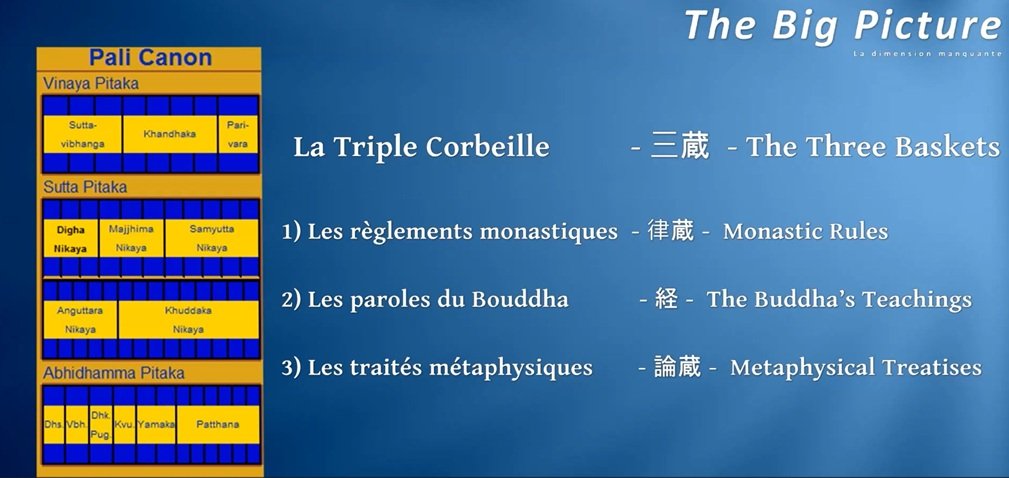
59§ Le pali joue le rôle d’une langue sacrée pour la Voie des Anciens qui l’utilise dans la liturgie, même si elle n’est plus comprise par les fidèles. Cette sacralisation explique la traduction en pali de textes bouddhistes cinghalais par Buddhaghosa, le grand commentateur du cinquième siècle à l’origine du célèbre commentaire du Visuddhimagga.
1. L’intégration de l’animisme
60§ Le bouddhisme de la Voie des Anciens a intégré les esprits des religions animistes autochtones en les incluant dans le cycle des renaissances : aspirant à la libération, ils se mettent au service des moines propagateurs du message du Bouddha.
61§ Deux exemples montrent comment le bouddhisme a intégré les divinités animistes en les subordonnant à la figure du Bouddha :
- alors que le Bouddha est en train de consolider son expérience de l’Éveil, un déluge survint qui menaçait de l’emporter : une divinité-serpent nommée Muchalinda a alors abrité le Bouddha sous les capuchons de ses sept têtes tandis qu’elle le surélevait par ses anneaux [Dans le Grand Véhicule, Nagarjuna aurait reçu des divinités serpent les textes sacrés de la « Perfection de la Sagesse » qu’elles protégeaient.]] ;
- l’enceinte d’un monastère thaï comporte une maison miniature montée sur pilier où sont déposées des offrandes pour la divinité locale du sol, afin qu’elle protège le monastère.
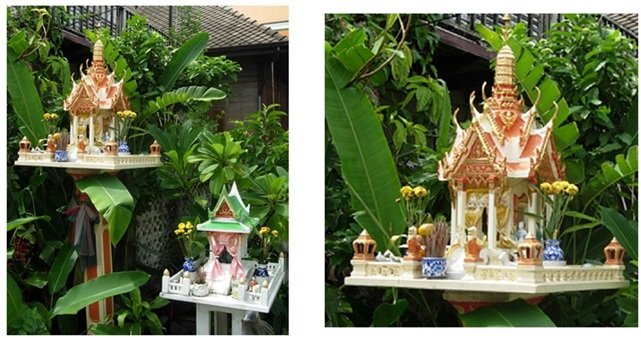
Autel du génie protecteur du sol dans un monastère thaï - (photo de l’auteur)
2. Le nationalisme
62§ L’Asie du Sud-Est, hors Vietnam, pratique majoritairement le bouddhisme de la Voie des Anciens. Il sert de marqueur identitaire dans les discours nationalistes pour justifier la violence envers les minorités ethniques : les Tamouls hindous du Sri Lanka, les Rohingyas musulmans du Myanmar et les Malais musulmans au sud de la Thaïlande.
63§ L’hebdomadaire américain Time affichait ainsi sur sa couverture du 1e juillet 2013 le portrait du moine birman U Wirathu, célèbre pour ses discours de haine contre les Rohingyas.
3. Le calendrier des fêtes
64§ Les fêtes les plus importances dans les sociétés d’Asie du Sud-Est portent sur le Bouddha Sakyamuni et sur la communauté des moines.
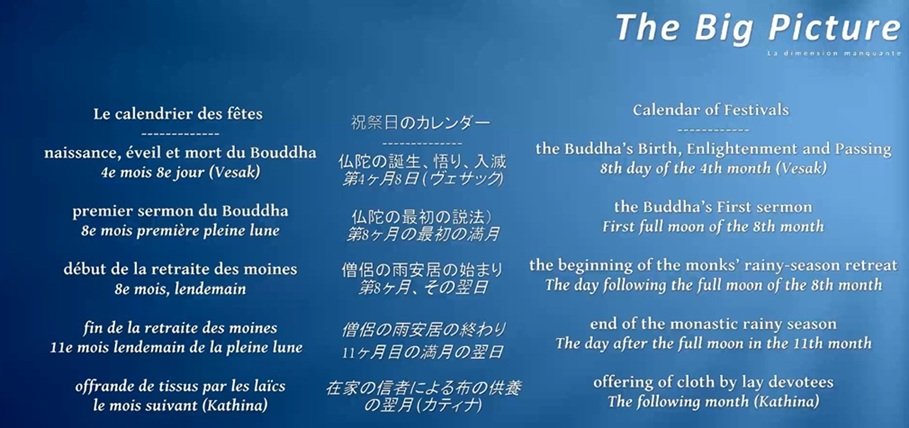
- 65§ La vie du Bouddha est commémorée par la fête de Vesak le huitième jour du quatrième mois lunaire qui célèbre la naissance, l’Éveil et la mort du Bouddha
- tandis que la fête de l’Asalha puja célèbre le premier sermon du Bouddha à la pleine lune du huitième mois.
66§ La retraite annuelle de trois mois des moines pendant la mousson donne lieu à différentes célébrations :
- la fête de Vassa célèbre le début de la retraite le lendemain de la fête du premier sermon du Bouddha à la pleine lune du huitième mois ;
- Paravana célèbre la fin de la retraite des moines le lendemain de la pleine lune du onzième mois ;
- les laïcs font des offrandes au monastère pendant la fête de Kathina qui est organisée dans le mois qui suit la fin de la retraite.
4. Le noviciat traditionnel des hommes
67§ La prégnance du bouddhisme dans la culture thaïe s’explique en particulier par le passage traditionnel des jeunes hommes thaïs au monastère : ils sont censés effectuer au moins une fois dans leur vie une période de noviciat pendant laquelle ils vivent dans le monastère. Le novice transfère les mérites ainsi acquis en premier lieu à sa mère qui n’a pas pu effectuer ce noviciat réservé aux garçons, puis à son père.
68§ Le passage en monastère a sans doute permis de donner un minimum d’éducation aux enfants des villageois, mais l’avenir de cette institution est menacé dans une société urbaine où la jeunesse des classes moyennes a goûté aux commodités du réfrigérateur et de l’Internet.
5. Le statut des novices femmes
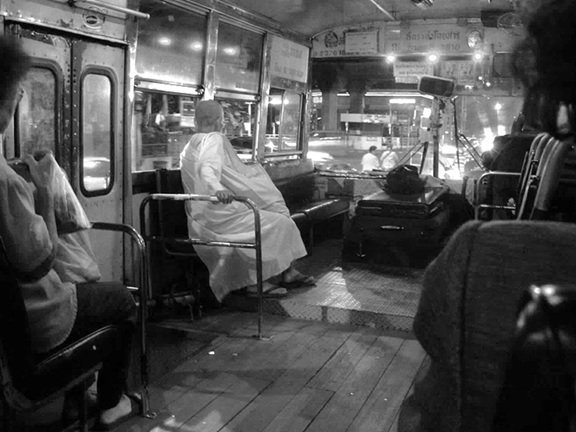
69§ Actuellement, les femmes novices ne peuvent accéder au statut de moniales à part entière en Asie du Sud-Est.
70§ La raison avancée tient à l’histoire : le rituel d’ordination monastique a été perdu au onzième siècle pendant l’invasion du Sri Lanka par l’empire tamoul hindou qui avait persécuté le bouddhisme. Le rituel pour les moines a été restauré à partir de la version transmise en Birmanie, mais qui ne comprenait pas le rituel pour les moniales.
71§ Le rituel pour les moniales existe cependant en langue chinoise et l’on pourrait imaginer sa rétro-traduction en pali, mais cette solution n’est pas retenue pour l’instant, peut-être à cause de la sacralisation du pali :le moindre écart par rapport à la formule originale perdue invaliderait la rétro-traduction ?
Chap. 2. L’idéal de la Voie des Anciens
72§ La Voie des Anciens se veut l’enseignement originel, non altéré du Bouddha Sakyamuni ; pour elle, les textes du Grand Véhicule sont des faux qui n’ont pas été prononcés par le Bouddha.
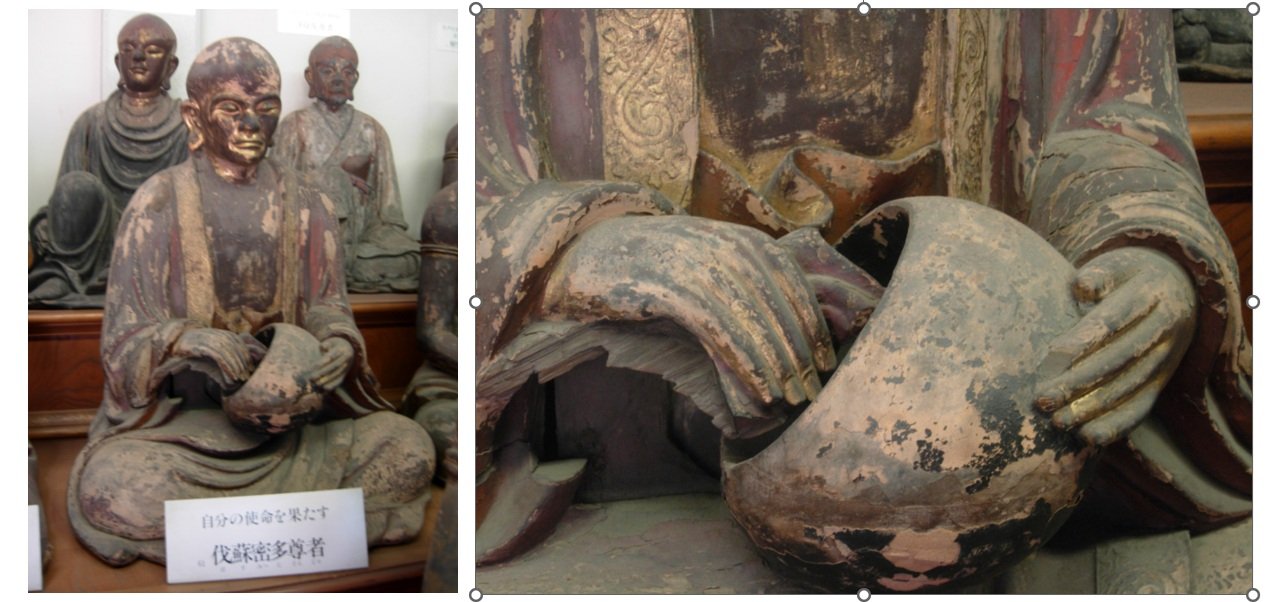
73§ La figure ultime de la Voie des Anciens est celle de l’être qui a mérité de ne plus renaître, le « Méritant » [4].
A la fin de sa dernière existence, il échappe au cycle des renaissances, ayant éteint en lui le feu des passions conformément aux Quatre nobles vérités.
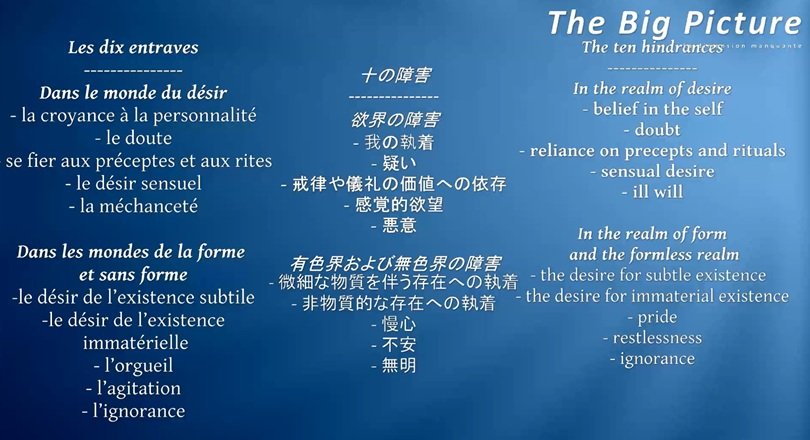
74§ Le moine qui avance sur l’Octuple sentier déracine les attachements sensuels du monde du désir, mais aussi les attachements spirituels comme le désir de renaître dans les espaces célestes et immatériels du monde de la forme et du monde sans forme [5].
Au fur et à mesure de sa progression, le pratiquant réduit son nombre de renaissances jusqu’à ne plus renaître qu’une fois avant d’entrer en Nirvana, ce qui caractérise l’état de « Méritant ».
La progression comprend quatre étapes successives :
- les disciples « entrés dans le courant » : ils sont assurés de ne plus renaître dans les destinées malheureuses ; ils renaîtront au plus six fois ;
- les disciples « ne renaissant plus qu’une fois » dans le monde humain ;
- les disciples « ne renaissant plus » dans le monde humain : ils atteindront le Nirvana dans les destinées célestes ;
- les disciples « méritants » : parvenus à leur dernière existence, ils ne renaîtront plus.
75§ Arrivés à ce point, nous pouvons préciser un point qui suscitera sans doute un abime de perplexité chez le lecteur : l’expression « entrer en Nirvana » n’a de sens que dans notre niveau de vérité relative. En rigueur de terme, l’âme étant un assemblage instable et provisoire d’éléments hétérogènes, elle ne peut pas entrer dans la réalité absolue : tel le personnage dans un rêve qui disparaît quand le dormeur se réveille.
76§ Buddhaghosa, un théoricien de la Voie des Anciens du cinquième siècle, a ainsi écrit : « Il y a Nirvana, mais personne n’est « nirvané » [personne n’entre en Nirvana] ».
Annexe : termes bouddhistes en sanskrit / pali et en chinois / japonais
Corbeille des Commentaires : Abhidhamma pitaka : 論藏
Corbeille des dits du Bouddha : Sutta pitaka : 經藏 /. 経蔵
Corbeille des règlements monastiques : Vinaya pitaka : 律藏 / 律蔵
Entrés dans le courant : sotapanna : 入流 : 預流
Ne renaissant plus qu’une fois : sakadàgâmin : 一来
Ne renaissant plus : anagamin : 不還
Méritant : Arhat : 羅漢
Moine : bhiksu : 比丘
Moniale : bhiksuni : 比丘尼
Novice moine : sramanera : 沙彌 / 沙弥
Novice moniale : sramaneri : 沙彌尼 / 沙弥尼
Voie des Anciens : Theravada : 上座部
© fr. Franck Guyen op, septembre 2026
English
This article is part of the following series : "The Big Picture - La grande image - Season 2"
YouTube Video : https://youtu.be/nD95eza5UVY
If you appreciate the esperer-isshoni.fr website on the web : you can make a donation to the community in which I live (click here to find out how)
Introduction to the religious and spiritual traditions of Asia : Buddhism (3/8) [6]
Warning. A gesture that is by no means insignificant
This gesture of engagement with other religions is by no means insignificant, and we must be aware of the implications of such an encounter.
A religion is something important, if not essential, to its followers ; therefore, we must not behave like casual tourists by approaching it with simplistic and reductive ideas. Such an encounter calls for humility – I did not say humiliation.
I also believe that this act requires us to be clear about our own faith, about what we believe. Otherwise, we risk being bewildered by proposals offering a complete system of meaning, each with its own internal coherence, which are not necessarily compatible with one another. [7]
2. The Way of the Ancients (Theravada) )
- Chapter 1. History of the Way of the Ancients
- Chapter 2. The ideal of the Path of the Ancients
- Appendix : Buddhist terms in Sanskrit/Pali and Chinese/Japanese
Chapter 1. History of the Way of the Ancients
57§ Buddhism spread throughout Indianised South-East Asia from the third century BCE : Sri Lanka [8], Myanmar, Thailand, Laos, Cambodia, and Indonesia (before the latter became Muslim in the eleventh century). The spread took place mainly by sea.
58§ The Path of the Ancients is based on the Tripitaka written in Pali, a language believed to have been spoken by the Buddha himself, although, according to philology, he is thought to have spoken Magadhi instead.
59§ Pali serves as a sacred language for the Path of the Ancients, which uses it in liturgy, even though it is no longer understood by the faithful. This sacralisation explains the translation into Pali of Sinhalese Buddhist texts by Buddhaghosa, the great fifth-century commentator responsible for the famous commentary on the Visuddhimagga.
1. The integration of animism into the Path of the Ancients
60§ The Buddhism of the Path of the Ancients has integrated the spirits of indigenous animist religions by including them in the cycle of rebirths : aspiring to liberation, they place themselves at the service of the monks who propagate the Buddha’s message.
61§ Two examples illustrate how Buddhism has integrated animist deities by subordinating them to the figure of the Buddha :
- whilst the Buddha was consolidating his experience of Enlightenment, a deluge struck which threatened to sweep him away : a serpent deity -serpent deity named Muchalinda then sheltered the Buddha beneath the hoods of its seven heads whilst lifting him up with its coils [In the Mahayana tradition, Nagarjuna is said to have received the sacred texts of the ‘Perfection of Wisdom’ from serpent deities, who were protecting them.] ] ;
- The grounds of a Thai monastery feature a miniature house mounted on a pillar where offerings are placed for the local earth deity, so that it may protect the monastery.
Altar to the guardian spirit of the land in a Thai monastery (photo by the author)
2. Nationalism
62§ In South-East Asia, with the exception of Vietnam, the majority practise Theravada Buddhism. It serves as a marker of identity in nationalist discourse to justify violence against ethnic minorities : the Hindu Tamils of Sri Lanka, the Muslim Rohingya of Myanmar and the Muslim Malays in southern Thailand.
63§ The American weekly Time featured on its 1 July 2013 cover a portrait of the Burmese monk U Wirathu, notorious for his hate speech against the Rohingya.
3. The calendar of festivals
64§ The most important festivals in Southeast Asian societies centre on the Buddha Sakyamuni and the monastic community.
- 65§ The life of the Buddha is commemorated by the festival of Vesak the eighth day of the fourth lunar month, which marks the Buddha’s birth, Enlightenment and passing away,
- whilst the festival of Asalha puja commemorates the Buddha’s first sermon on the full moon of the eighth month.
66§ The monks’ annual three-month retreat during the monsoon gives rise to various celebrations :
- the festival of Vassa marks the start of the retreat on the day after the festival commemorating the Buddha’s first sermon on the full moon of the eighth month ;
- Paravana marks the end of the monks’ retreat on the day after the full moon of the eleventh month ;
- laypeople make offerings to the monastery during the festival of Kathina, which is held in the month following the end of the retreat.
4. The traditional novitiate for men
67§ The prevalence of Buddhism in Thai culture can be explained in particular by the traditional practice of young Thai men entering the monastery : they are expected to undertake a period of novitiate at least once in their lives, during which they live in the monastery. The novice transfers the merits thus acquired first to his mother, who was unable to undertake this novitiate reserved for boys, and then to his father.
68§ The period spent in a monastery undoubtedly helped to provide the villagers’ children with a basic education, but the the future of this institution is under threat in an urban society where middle-class youth have come to enjoy the conveniences of the fridge and the internet.
5. The status of female novices
69§ At present, female novices cannot attain the status of full-fledged nuns in .
70§ The reason given is historical : the monastic ordination ritual was lost in the eleventh century during the invasion of Sri Lanka by the Hindu Tamil Empire, which had persecuted Buddhism. The ritual for monks was restored from the version transmitted in Burma, but this did not include the ritual for nuns.
71§ The ritual for nuns does, however, exist in Chinese, and one might envisage its back-translation into Pali ; yet this solution has has not been adopted for the time being, perhaps due to the sacralisation of Pali : would the slightest deviation from the lost original formula invalidate the back-translation ?
Chapter 2. The ideal of the Path of the Ancients
72§ The Path of the Ancients claims to be the original, unaltered teaching of the Buddha Sakyamuni ; for this tradition, the Mahayana texts are forgeries that were not spoken by the Buddha.
73§ The ultimate figure in the Way of the Ancients is that of the being who has earned the right to be free from rebirth, the ‘Meritorious One’ ’ [9].
At the end of his final existence, he escapes the cycle of rebirths, having extinguished within himself the fire of passions in accordance with the Four Noble Truths.
74§ The monk who progresses along the Noble Eightfold Path uproots the sensual attachments of the realm of desire, but also spiritual attachments such as the desire to be reborn in the celestial and immaterial realms of the world of form and the formless world [10]. As he progresses, the practitioner reduces the number of his rebirths until he is reborn only once more before enter Nirvana, which characterises the state of ‘ Meritorious One (Arhat)’.
Progress comprises four successive stages :
- disciples who have ‘entered the stream’ : they are assured of no longer being reborn in the unhappy realms ; they will be reborn no more than six times ;
- disciples who will be ‘reborn only once more’ in the human realm ;
- disciples who ‘will be reborn no more’ in the human realm : they will attain Nirvana in the heavenly realms ;
- ‘meritorious’ disciples : having reached their final existence, they will be reborn no more.
75§ Having reached this point, we may clarify a point that will no doubt give rise to a great deal of perplexity in the reader : the expression ‘to enter Nirvana’ only makes sense within our realm of relative truth. Strictly speaking, as the soul is an unstable and temporary assemblage of heterogeneous elements, it cannot enter into absolute reality : just as a figure in a dream vanishes when the sleeper awakens.
76§ Buddhaghosa, a fifth-century theorist of the Path of the Ancients, wrote : ‘There is Nirvana, but no one is “nirvanised” [no one enters Nirvana].’
Appendix : Buddhist terms in Sanskrit/Pali and Chinese/Japanese
Collection of monastic rules : Vinaya pitaka : 律藏 / 律蔵
Collection of the Comments : Abhidhamma pitaka : 論藏
Collection of the Buddha’s Sayings : Sutta pitaka : 經藏 / 経蔵
Entered the stream’ : sotapanna : 入流 : 預流
Reborn only once more : sakadàgâmin : 一来
Reborn no more’ : anagamin : 不還
Meritorious One : Arhat : 羅漢
Monk : bhiksu : 比丘
Nun : bhiksuni : 比丘尼
Novice moine : sramanera : 沙彌 / 沙弥
Novice moniale : sramaneri : 沙彌尼 / 沙弥尼
Way of the Ancients : Theravada : 上座部
© Franck Guyen op, February 2022
© fr. Franck Guyen op, September 2026
日本語
この記事は以下のシリーズの一部です : "The Big Picture - La grande image - シーズン2"
YouTube Video : https://youtu.be/nD95eza5UVY
もしウェブ上の esperer-isshoni.fr というウェブサイトを気に入ってくれたなら、私が暮らすコミュニティへ寄付をすることができる([寄付方法はこちら→https://dominicainslille.fr/?page_id=84])
アジアの宗教・精神伝統入門 - 仏教 (3/8) [11]
警告。。決して些細ではない姿勢
他の宗教と関わるというこの姿勢は決して些細なものではなく、我々はそうした出会いがもたらす意味合いを認識しなければならない。
宗教とは、信者にとって不可欠とまではいかなくとも重要なものである。したがって、単純化され、矮小化された考えでそれに接し、まるで気ままな観光客のように振る舞ってはならない。そのような出会いに求められるのは謙虚さだ――屈辱ではない。
また、この行為には、私たち自身の信仰、すなわち私たちが何を信じているのかについて、明確にしておくことが求められると私は考える。そうでなければ、それぞれ独自の内部的整合性を持ち、必ずしも互いに両立するとは限らない、完全な意味体系を提示する提案に、私たちは戸惑ってしまう危険がある。 [12]
2. 上座部仏教
第1章. 歴史
57§ 仏教は紀元前3世紀から、インド文化の影響を受けた東南アジア全域に広まった。スリランカ [13]、ミャンマー、タイ、ラオス、カンボジア、そしてインドネシア(同国が11世紀にイスラム化される以前)である。その伝播は主に海路によって行われた。
58§ 「上座部仏教」は、パーリ語で書かれた三蔵に基づいている。パーリ語は仏陀自身が話していたと信じられている言語だが、言語学的には、仏陀はむしろマガダ語を話していたと考えられている。
59§ パーリ語は「上座部仏教」にとって神聖な言語であり、信者にはもはや理解されていないにもかかわらず、典礼において使用されている。この神聖化こそが、5世紀の偉大な注釈者ブッダゴーサによるシンハラ語仏教経典のパーリ語への翻訳を説明している。同氏は、『清浄道論』の有名な注釈を著した人物である。
1. 「上座部仏教」へのアニミズムの統合
60§ 「上座部仏教」の仏教は、先住のアニミズム宗教の精霊たちを輪廻の循環に取り込むことで統合してきた。解脱を志す精霊たちは、仏の教えを広める僧侶たちに仕えるのである。
61§ 仏教がアニミズムの神々を仏の御姿に従属させることでいかに統合したかを示す二つの例がある:
- 仏が悟りの体験を確固たるものにしていく最中、大洪水が襲い、仏を押し流しかねない状況となった。その時、ムチャリンダという名の蛇の神が、その七つの頭の頭蓋の下に仏を保護しつつ、自らの体を巻きつけて仏を持ち上げた。[大乗仏教の伝統では、ナーガールジュナは、経典を守護していた蛇の神々から『般若波羅蜜多』の聖典を受け取ったとされている。] ] ;
- タイの僧院の敷地内には、柱の上に設置されたミニチュアの家があり、そこへ地元の地神への供物が捧げられ、僧院を守ってもらえるよう願われている。
タイの寺院にある、その土地の守護霊を祀る祭壇(写真:筆者撮影)
2. ナショナリズム
62§ 東南アジアでは、ベトナムを除き、大多数が上座部仏教を信仰している。これは、スリランカのヒンドゥー教徒であるタミル人、ミャンマーのイスラム教徒であるロヒンギャ、そしてタイ南部のイスラム教徒であるマレー人といった少数民族に対する暴力を正当化するための、ナショナリズム的言説におけるアイデンティティの指標として機能している。
63§ 米国の週刊誌『タイム』は、2013年7月1日号の表紙に、ロヒンギャに対するヘイトスピーチで悪名高いビルマの僧侶ウ・ウィラトゥの肖像を掲載した。
3. 祭りの暦
64§ 東南アジア社会における最も重要な祭事は、釈迦牟尼仏と僧伽を中心に展開している。
- 65§ 仏陀の生涯は、ヴェサックという祭りで記念される。これは旧暦4月8日にあたり、仏陀の誕生、悟り、入滅を祝うものである。
- 一方、アサルハ・プジャという祭りは、旧暦8月の満月の日に仏陀が初めて説法を行ったことを記念するものである。
66§ モンスーンの時期に行われる僧侶たちの年1回の3ヶ月間の安居(ヴァッサ)には、様々な祝祭が伴う:
- ヴァッサの祭りは、8月の満月の日に仏陀が最初の説法を行ったことを記念する祭りの翌日に、安居の始まりを告げるものである;
- パラヴァナは、第11月の満月の翌日に僧侶たちの安居の終わりを告げる;
- 信徒たちは、安居の終了後の月に開催されるカティナの祭りの期間中、寺院へ供養を行う。
4. 男性のための伝統的な見習い修行
67§ タイ文化における仏教の浸透は、特に若いタイ人男性が僧院に入るという伝統的な慣習によって説明できる。彼らは生涯に少なくとも一度、僧院で生活しながら見習い修行を行うことが期待されている。見習い僧は、こうして得た功徳を、まず、男子にのみ許されたこの見習い修行を行うことができなかった母親に、次に父親に譲る。
68§ 寺院で過ごした期間は、村人の子供たちに基礎教育を与える上で間違いなく役立ったが、中流階級の若者が冷蔵庫やインターネットの利便性を享受するようになった都市社会において、この制度の将来は脅かされている。
5. 女子見習い修道者の地位
69§ 現在、女子見習い修道者は、において本格的な尼僧の地位を得ることはできない。
70§ その理由は歴史的なものである。11世紀、仏教を迫害していたヒンドゥー教のタミル帝国によるスリランカ侵攻の際に、尼僧の得度儀式が失われてしまったためだ。比丘の儀式はビルマで伝承されていた版本から復元されたが、尼僧の儀式は含まれていなかった。
71§ しかし、尼僧のための儀式は中国語で現存しており、それをパーリ語へ逆翻訳することも考えられる。とはいえ、おそらくパーリ語の神聖化のためか、この解決策は今のところ採用されていない。失われた元の儀式文からわずかにでも逸脱すれば、その逆翻訳は無効になってしまうのだろうか?
第2章. 理想
72§ 「上座部仏教」は、釈迦牟尼仏による原本のままの、改変されていない教えであると主張している。この伝統によれば、大乗の経典は仏が説いたものではない偽作である。
73§ 「上座部仏教」における究極の存在とは、輪廻から解脱する権利を獲得した者、すなわち「阿羅漢(アラハント)」である。 [14]
その最後の生が終わる時、彼は四聖諦に従って自らの内に煩悩の火を消し尽くし、輪廻の連鎖から解脱する。
74§ 八正道に沿って歩む比丘は、欲界の感覚的な執着を断ち切るだけでなく、有形界や無形界といった天界や無色界に生まれ変わりたいという願望といった精神的な執着も断ち切る [15]。修行が進むにつれ、修行者は転生の回数を減らし、最終的に涅槃に入る前にあと一度だけ転生することになる。これが「聖者」の状態の特徴である。
修行の進展は、以下の4つの段階からなる:
- 「入流」した弟子たち:彼らはもはや苦の領域に生まれ変わることはないと保証されており、生まれ変わる回数は6回以下となる;
- 人間界に「あと一度だけ」生まれ変わる弟子たち;
- 人間界に「二度と生まれ変わらない」弟子たち:彼らは天界において涅槃に達する;
- 「阿羅漢(アラハント)」弟子たち:最後の生に達した後、彼らは二度と生まれ変わらない。
75§ ここまで来たところで、読者にとって間違いなく大きな困惑を招くであろう一点を明確にしておこう。「涅槃に入る」という表現は、相対的な真実の領域内でのみ意味をなす。厳密に言えば、魂は不安定で一時的な異質な要素の集合体であるため、絶対的な現実に入ることはできない。それは、眠りから覚めたときに夢の中の姿が消え去るのと同じである。
76§ 5世紀の「上座部仏教」の理論家ブッダゴーサは、次のように記している。「涅槃は存在するが、誰も『涅槃化』されることはない[誰も涅槃に入ることはない]。」
© フランク・ギエン op、2022年2月
© フランク・ギエン op、2026年9月
[1] Les articles synthétisent un cours de 24h dispensé sur un an à la Faculté de théologie de Lille. Nous avons assuré ce cours de 2010 à 2023
[3] D’après la légende, le Bouddha Sakyamuni s’est rendu sur l’île du Sri Lanka par la voie des airs : une pierre sur le Pic du mont Adam est censée porter l’empreinte de son pied lorsqu’il se posa sur l’île.
[4] Dans la Voie des Anciens, le plus haut titre du Bouddha est d’avoir réalisé l’état de « Méritant » par lui-même, sans l’aide d’un maître
[5] voir la description du Triple monde
[6] These articles summarise a 24-hour course taught over the course of a year at the Faculty of Theology in Lille. We have been teaching this course for around ten years.
[7] View the text Engaging with Asian religions : my statement of intent
[8] According to legend, the Buddha Sakyamuni travelled to the island of Sri Lanka by air : a stone on Adam’s Peak is said to bear the imprint of his foot when he landed on the island.
[9] In the Way of the Ancients, the highest title a Buddha can attain is to have realised the state of ‘the Meritorious One’ through his own efforts, without the aid of a teacher
[11] これらの記事は、リールの神学部で1年間にわたり開講された24時間の講座をまとめたものである。当講座は約10年にわたり開講されている。
[12] アジアの宗教との関わり:私の意向表明 を見る]
[13] 伝説によれば、釈迦牟尼仏は空を飛んでスリランカ島へ渡ったという。アダムズ・ピークにある石には、彼が島に降り立った際の足跡が刻まれていると伝えられている。
[14] 「上座部仏教」において、仏が到達しうる最高の称号は、師の助けを借りることなく、自らの努力によって「阿羅漢(アラハント)」の境地を悟ることである。
