S2-B8. Quelques réflexions à propos de la Vierge Marie - 聖母マリアについての一考察 - Reflections on the Virgin Mary
popularité : 21%

| Texte en français | English Text | 日本語のテキスト |
YouTube Video : https://youtu.be/H-65CUC3ZFA
Français
Cet article fait partie de "The Big Picture - La grande image - Saison 2"
YouTube Video : https://youtu.be/H-65CUC3ZFA
Vous appréciez la présence du site esperer-isshoni.fr sur le Web : vous pouvez faire un don à la communauté dans laquelle je vis (cliquer ici pour voir comment procéder)
Table des matières [1].
- « Je vous salue… »
- « Le Seigneur est avec vous »
- « Je suis la servante du Seigneur. Qu’il m’advienne selon ta parole »
- « Comblée de grâce »
1. « Je vous salue Marie »
1§ L’archange Gabriel salue ainsi Marie en entrant dans sa maison à Nazareth. Le frère dominicain Thomas d’Aquin (1225-1226 ? ; 1274) s’étonnait qu’un archange, c’est-à-dire une créature spirituelle de très haut rang, marque un tel respect pour une créature charnelle [2]
Un aparté sur les anges
2§ Les anges, rappelons-le, sont des esprits immatériels. Comme nous, ils ont été créés par Dieu, mais dans le monde invisible [3]. Comme nous, ils ont reçu le commandement d’aimer Dieu de tout leur être, dans la louange et le service.
3§ Et comme nous, ces esprits peuvent décider d’obéir ou de désobéir, à la différence près que leur décision est irrévocable, contrairement à nous, d’après Thomas d’Aquin. En effet, les purs esprits peuvent saisir instantanément la vérité des choses, aussi ne commettent-ils pas d’erreur dans leur décision, alors que nous accédons à la vérité à partir de notre condition corporelle, qui est faillible.
4§
- Qu’ils choisissent d’obéir à Dieu, et ils seront pour nous des anges envoyés par Dieu pour nous guider dans notre ascension vers le grand bonheur de la vision transformante de Dieu
- Qu’ils se décident pour la désobéissance, et ils seront des démons envoyés par Satan pour nous entraîner avec eux dans leur chute vers le grand malheur de la privation de la vision de Dieu.
Fin de l’aparté.
2. « Le Seigneur est avec vous »
5§ Revenons à l’étonnement de Thomas d’Aquin. Comment se fait-il qu’un ange du cercle le plus rapproché de Dieu s’incline devant une simple jeune fille, issue d’un peuple quelconque et habitant dans un village quelconque ?
6§ Je crois que l’ange Gabriel a perçu le rôle central de Marie dans le projet de réconciliation que Dieu est en train de mettre en place avec sa création.
7§ Je crois que Marie est ce que la création pouvait offrir de mieux pour accueillir dans la chair le Fils de Dieu, elle est sa plus fine fleur.
8§ Et je crois que Dieu a concouru à la beauté de Marie en la préservant du péché originel, cette faille qui lézarde la création entière et qui l’empêche de répondre à l’amour de Dieu autant qu’elle le voudrait.
9§ Je crois qu’il a fallu ce que l’Église catholique appelle la grâce de l’Immaculée conception pour que Marie puisse acquiescer à un projet qui aurait écrasé n’importe quelle créature à part elle.
10§ Voilà pourquoi sans doute l’archange Gabriel s’incline devant Marie : il voit que Dieu est en train d’accomplir avec elle et en elle une chose inouïe qu’aucune créature aussi bien du ciel que de la terre n’avait prévu : le Fils du Père va prendre chair pour sauver la création, et cela dépendra de l’acceptation d’une créature tirée de la glaise, une humaine, une femme.
11§ Essayons d’imaginer ce moment.
L’ambassadeur de Dieu Gabriel a dit ce qu’il avait à dire, il a fini de parler. C’est maintenant à Marie de prendre la parole. Elle prend le temps de méditer dans son cœur la proposition de l’ange avant de répondre.
12§ Un silence s’installe, d’une gravité infinie parce que ce qui se joue dans sa réponse dépasse infiniment tout ce qu’on peut imaginer. La terre entière attend, suspendue aux lèvres de Marie, et pas seulement la terre, mais le ciel aussi, et pas seulement le ciel mais aussi les Trois personnes divines.
3. « Je suis la servante du Seigneur. Qu’il m’advienne selon ta parole ».
13§ Marie a dit « Oui ». Quelle n’a pas été la joie des anges au plus haut du ciel à ce moment-là ? Quelle n’a pas été la joie d’Ève au plus profond de la terre ?
14§ Marie a dit oui au projet de Dieu, un oui sans retour, sans savoir jusqu’où ce oui l’entraînerait : à l’autre bout de l’histoire, au pied de la croix.
15§ Et elle reste debout. Elle ne comprend pas, mais elle continue de faire confiance à la parole prononcée au début de l’histoire : non, l’ange n’a pas menti, non, Dieu n’a pas menti.
16§ Marie se tient debout, elle résiste à ce qui aurait écrasé n’importe qui à part elle, ni à l’Annonciation ni à la Passion, et parce qu’elle a supporté l’insupportable, elle est devenue mère : la mère du Fils de Dieu à l’Annonciation, mère de la multitude des frères et sœurs en Jésus Christ à la Passion.
17§ Voilà pourquoi sans doute Gabriel s’incline en entrant chez cette jeune fille de Galilée. Il salue non pas une servante, mais la servante de Dieu, il salue celle qui a rendu un service qu’aucune autre créature n’aurait pu rendre, avec ailes ou sans ailes.
4. « Comblée de grâce »
18§ Si nous vénérons Marie avec l’ange, il n’est cependant pas question de l’adorer, sinon nous tomberions dans l’idolâtrie en confondant l’ordre du créé et l’ordre de l’incréé.
19§ Marie est la plus belle des créatures, mais c’est une créature, aussi n’attendons pas d’elle ce que seul Dieu peut donner.
20§ Marie n’a pas toujours existé, à la différence de Jésus qui a revendiqué d’avoir été avant Abraham, provoquant l’opposition des autorités religieuses qui l’écoutaient.
21§ C’est du flanc transpercé de Jésus qu’ont coulé le sang et l’eau, source du salut pour celui qui croit en lui, et non pas du flanc de Marie. Et c’est au corps et au sang du Christ que communie le croyant, et non au corps et au sang de Marie.
22§ Partons d’une analogie tirée de l’astronomie : la lune dispense de la lumière mais c’est en la reflétant, non en la produisant. C’est le soleil qui produit la lumière par les réactions thermonucléaires en son sein.
Par conséquent, la lune est bien source de lumière, mais en tant que source dérivée, en tant que source seconde.
23§ La lune appartient à l’ordre des planètes, le soleil à l’ordre des étoiles, sans qu’on puisse les confondre, et l’un subordonné à l’autre.
24§ Marie n’est pas la source originelle de la grâce divine de même que la lune n’est pas la source de la lumière solaire, mais, elle est bien une dispensatrice de la grâce de Dieu, de même que la lune dispense la lumière du soleil.
25§ Appuyons-nous ici une dernière fois sur Thomas d’Aquin. Dans son Commentaire de la salutation angélique, il écrira que Marie est tellement comblée de grâce qu’elle en déborde, tel un vase rempli à ras bord et qu’on continue de remplir. Thomas dira que la grâce remplit d’abord l’âme de Marie avant de déborder sur sa chair, qui à son tour déborde de cette même grâce à l’extérieur. Marie dispense la grâce parce qu’elle en est comblée à en déborder.
26§ L’ange Gabriel savait ce qu’il faisait quand il s’inclinait devant Marie.
© fr. Franck Guyen op, octobre 2026
ENGLISH
This article is part of ‘The Big Picture - La grande image - Season 2’
YouTube Video : https://youtu.be/H-65CUC3ZFA
If you appreciate the esperer-isshoni.fr website on the web : you can make a donation to the community in which I live (click here to see how to do so)
Table of Contents [4].
- ‘Hail Mary…’
- ‘The Lord is with you’
- “I am the handmaid of the Lord. May it be done to me according to your word”
- “Full of grace”
1. ‘Hail Mary’
1§ The Archangel Gabriel greets Mary in this way upon entering her home in Nazareth. The Dominican friar Thomas Aquinas (1225–1226 ? ; 1274) was astonished that an archangel—that is to say, a spiritual creature of the highest rank— should show such respect for a creature of flesh and blood [5]
A digression on angels
2§ Angels, let us remember, are immaterial spirits. Like us, they were created by God, but in the invisible world [6]. Like us, they have been commanded to love God with their whole being, in praise and service.
3§ And like us, these spirits can choose to obey or disobey, with the difference that their decision is irrevocable, unlike ours, according to Thomas Aquinas. Indeed, pure spirits can instantly grasp the truth of things, and so they do not err in their decisions, whereas we arrive at the truth from our bodily condition, which is fallible.
4§If they choose to obey God, they will be, for us, angels sent by God to guide us in our ascent towards the great bliss of the transforming vision of God
If they choose disobedience, they will be demons sent by Satan to drag us down with them into their fall towards the great misery of being deprived of the vision of God.
End of aside.
2. ‘The Lord is with you’
5§ Let us return to Thomas Aquinas’s astonishment. How is it that an angel from God’s innermost circle should bow down before a simple young girl, born of an ordinary people and living in an ordinary village ?
6§ I believe that the angel Gabriel perceived Mary’s central role in the plan of reconciliation that God is bringing about with his creation.
7§ I believe that Mary is the very best that creation could offer to welcome the Son of God into the flesh ; she is its finest flower.
8§ And I believe that God contributed to Mary’s beauty by preserving her from original sin, that flaw which mars the whole of creation and prevents it from responding to God’s love as fully as it would wish to.
9§ I believe that what the Catholic Church calls the grace of the Immaculate Conception was necessary for Mary to consent to a plan that would have overwhelmed any creature other than herself.
10§ This is no doubt why the Archangel Gabriel bows before Mary : he sees that God is accomplishing through her and within her something unprecedented that no creature, whether in heaven or on earth, had foreseen : the Son of the Father is to become flesh to save creation, and this will depend on the acceptance of a creature fashioned from clay, a human being, a woman.
11§ Let us try to imagine this moment.
God’s messenger Gabriel has said what he had to say ; he has finished speaking. It is now Mary’s turn to speak. She takes time to ponder the angel’s proposal in her heart before replying.
12§ A silence descends, one of infinite gravity, for what is at stake in her response infinitely surpasses anything one can imagine. The whole earth waits, hanging on Mary’s every word, and not only the earth, but heaven too, and not only heaven, but also the Three Divine Persons.
3. ‘I am the handmaid of the Lord. Let it be done to me according to your word.’
13§ Mary said ‘Yes’. How great must have been the joy of the angels in the highest heavens at that moment ? How great must have been the joy of Eve in the depths of the earth ?
14§ Mary said ‘yes’ to God’s plan, an irrevocable ‘yes’, without knowing how far that ‘yes’ would lead her : to the very end of history, to the foot of the cross.
15§ And she remains standing. She does not understand, but she continues to trust the word spoken at the beginning of history : no, the angel did not lie ; no, God did not lie.
16§ Mary stands firm ; she withstands what would have crushed anyone but her, both at the Annunciation and at the Passion, and because she bore the unbearable, she became a mother : the mother of the Son of God at the Annunciation, mother of the multitude of brothers and sisters in Jesus Christ at the Passion.
17§ This is no doubt why Gabriel bows as he enters the home of this young girl from Galilee. He greets not a handmaid, but the handmaid of God ; he greets the one who has rendered a service that no other creature, winged or wingless, could have rendered.
4. ‘Full of grace’
18§ Whilst we venerate Mary alongside the angel, we must not worship her ; otherwise we would fall into idolatry by confusing the order of the created with that of the uncreated.
19§ Mary is the most beautiful of all creatures, but she is a creature ; therefore, let us not expect from her what only God can give.
20§ Mary has not always existed, unlike Jesus, who claimed to have existed before Abraham, thereby provoking opposition from the religious authorities who were listening to him.
21§ It was from Jesus’ pierced side that blood and water flowed—the source of salvation for those who believe in him—and not from Mary’s side. And it is the body and blood of Christ that the believer receives in communion, and not the body and blood of Mary.
22§ Let us begin with an analogy drawn from astronomy : the moon provides light, but it does so by reflecting it, not by producing it. It is the sun that produces light through thermonuclear reactions within it.
Consequently, the moon is indeed a source of light, but as a derived source, as a secondary source.
23§ The moon belongs to the order of the planets, the sun to the order of the stars ; the two cannot be confused, and one is subordinate to the other.
24§ Mary is not the original source of divine grace, just as the moon is not the source of the sun’s light ; yet she is indeed a dispenser of God’s grace, just as the moon dispenses the sun’s light.
25§ Let us turn once more to Thomas Aquinas. In his Commentary on the Angelic Salutation, he writes that Mary is so filled with grace that it overflows, like a vessel filled to the brim which is still being filled. Thomas states that grace first fills Mary’s soul before overflowing into her body, which in turn overflows with this same grace outwards. Mary bestows grace because she is so filled with it that it overflows.
26§ The angel Gabriel knew what he was doing when he bowed before Mary.
© Fr. Franck Guyen OP, October 2026
日本語
この記事は 「The Big Picture - La grande image - シーズン2」 の一部です
YouTube動画 : https://youtu.be/H-65CUC3ZFA
ウェブ上の esperer-isshoni.fr ウェブサイトを気に入っていただけた場合は、私が暮らすコミュニティへ寄付を行うことができます([寄付方法はこちらをクリック→https://dominicainslille.fr/?page_id=84]
目次 [7].
1. 「アヴェ・マリア」
1§ 大天使ガブリエルは、ナザレにあるマリアの家に入った際、このように彼女に挨拶した。ドミニコ会の修道士トマス・アクィナス(1225年–1226年? ; 1274年)は、大天使――すなわち、最高位の霊的存在――が、肉と血の被造物に対してこれほどまでの敬意を示すことに驚嘆した [8]
天使に関する余談
2§ 天使とは、忘れてはならないが、無形の霊である。私たちと同様に、彼らは神によって創造されたが、それは目に見えない世界においてである [9]。私たちと同様に、彼らもまた、賛美と奉仕を通じて、全存在をもって神を愛するよう命じられている。
3§ そして私たちと同様に、これらの霊も従うか従わないかを選択することができますが、トマス・アクィナスによれば、私たちとは異なり、彼らの決定は取り消すことができないという点で異なります。実際、純粋な霊は物事の真理を瞬時に把握することができるため、決定において誤りを犯すことはありません。一方、私たちは誤りを犯しうる肉体的な状態から真理に到達するのです。
4§もし彼らが神に従うことを選ぶならば、私たちにとっては、神の変容的な御姿を見るという大いなる至福へと向かう私たちの昇華を導くために、神によって遣わされた天使となるでしょう
もし彼らが不従順を選ぶならば、サタンによって遣わされた悪魔となり、私たちを彼らと共に引きずり下ろし、神の御姿を見ることを奪われるという大いなる悲惨へと向かう堕落へと導くことになるでしょう。
補足終了。
2. 「主はあなたと共におられる」
5§ トマス・アクィナスの驚嘆に立ち返ってみよう。どうして、神の最も内なる輪に属する天使が、平凡な民に生まれ、平凡な村に住む、ごく普通の若い娘の前にひれ伏すことができたのだろうか?
6§ 私は、天使ガブリエルが、神が被造物と成し遂げようとしている和解の計画において、マリアが果たす中心的な役割を認識していたと信じている。
7§ 私は、マリアこそが、神の御子を肉体に迎え入れるために被造物が捧げ得る最高の存在であり、被造物の最も美しい花であると信じている。
8§ そして私は、神がマリアを原罪から守ることで、その美しさをさらに高められたと信じている。原罪とは、被造物全体を損ない、被造物が望むほどに神の愛に応えることを妨げる欠陥である。
9§ カトリック教会が「無原罪の御宿り」の恵みと呼ぶものは、マリアが、彼女以外のいかなる被造物をも圧倒してしまうような計画に同意するために必要であったと、私は信じている。
10§ これこそが、大天使ガブリエルがマリアの前にひざまずく理由に違いない。彼は、神がマリアを通して、またマリアの内に、天にも地にもいかなる被造物も予見できなかった前例のないことを成し遂げようとしているのを見抜いているのだ。すなわち、父なる神の御子が被造物を救うために人となること、そしてそれが、土から造られた被造物、すなわち人間であり、女性であるマリアの承諾にかかっているのだ。
11§ この瞬間を想像してみよう。
神の使者ガブリエルは、伝えるべきことを語り終えた。次はマリアが語る番である。彼女は答える前に、心の中で天使の提案をじっくりと熟考する。
12§ 沈黙が降り注ぐ。それは計り知れない重みを持つ沈黙である。なぜなら、彼女の答えにかかっていることは、人が想像しうるあらゆるものを無限に超えているからである。全地がマリアの一言一句に耳を傾けて待ちわびている。そして、地だけでなく天も、天だけでなく、三位一体の神々もまた、その答えを待っている。
3. 「私は主のしもべです。お言葉どおりに、この身におこなってください。」
13§ マリアは「はい」と答えました。その瞬間、至高の天にいる天使たちの喜びは、どれほど大きかったことか。地の深みにあるエバの喜びは、どれほど大きかったことか。
14§ マリアは神の計画に「はい」と答えました。それは取り消すことのできない「はい」であり、その「はい」が彼女をどこまで導くのか――歴史の果て、十字架のふもとへと――を知らずに。
15§ そして、彼女は立ち続けている。彼女は理解できないが、歴史の始まりに語られた言葉を信じ続けている。いいえ、天使は嘘をつかなかった。いいえ、神は嘘をつかなかった。
16§ マリアは揺るぎなく立ち続けている。受胎告知の時も、受難の時も、彼女以外なら誰であれ押しつぶされてしまったであろう試練に耐え抜いた。そして、耐え難いものを背負ったからこそ、彼女は母となった。受胎告知の時には神の御子の母となり、受難の時にはイエス・キリストにある数え切れない兄弟姉妹たちの母となったのである。
17§ ガブリエルがガリラヤのこの若い娘の家に入る際に頭を下げたのは、間違いなくこのためである。彼は単なるしもべではなく、神のしもべに挨拶をしたのである。彼は、翼のある者も翼のない者も、他のいかなる被造物も成し得なかった奉仕を成し遂げた者に挨拶をしたのである。
4. 「恵みに満ちた方」
18§ 私たちは天使と共にマリアを崇敬する一方で、彼女を礼拝してはならない。さもないと、被造物の秩序と非被造物の秩序を混同し、偶像崇拝に陥ることになるからである。
19§ マリアはすべての被造物の中で最も美しい存在であるが、彼女は被造物に過ぎない。したがって、神のみが与えることのできるものを、彼女に期待してはならない。
20§ マリアは、アブラハム以前から存在していたと主張し、それによって彼女の話を聞いていた宗教当局者たちの反発を招いたイエスとは異なり、常に存在していたわけではない。
21§ イエスの刺し貫かれた脇腹から、彼を信じる者たちの救いの源である血と水が流れ出たのであり、マリアの脇腹からではなかった。また、信者が聖体拝領において受けるのは、キリストの体と血であり、マリアの体と血ではない。
22§ まず、天文学に例えて説明しよう。月は光を提供するが、それは光を放出しているのではなく、反射しているに過ぎない。光を放出しているのは、その内部での熱核反応によって光を発生させている太陽である。
したがって、月は確かに光の源ではあるが、それは派生した源、すなわち二次的な源としてである。
23§ 月は惑星の秩序に属し、太陽は恒星の秩序に属する。この二つは混同することはできず、一方は他方に従属している。
24§ マリアは、月が太陽の光の源ではないのと同様に、神の恩寵の本来の源ではない。しかし、月が太陽の光を配るように、彼女は確かに神の恩寵の分配者である。
25§ もう一度、トマス・アクィナスに目を向けよう。彼の『天使の挨拶に関する注解』(Commentary on the Angelic Salutation)において、トマスは、マリアは恵みに満ち溢れており、それはまるで縁まで満たされた器にさらに注ぎ込まれ続けているかのように、あふれ出ていると記している。トマスは、恵みがまずマリアの魂を満たし、それから彼女の身体へと溢れ出し、その身体もまた同じ恵みで外へと溢れ出ると述べている。マリアが恵みを授けるのは、彼女が恵みに満ち溢れ、それがあふれ出ているからである。
26§ 天使ガブリエルは、マリアの前にひれ伏したとき、自分が何をしているかをよく理解していた。
© フランク・ギエン神父 OP、2026年10月
[1] Cet article reprend un enseignement aux Équipes du Rosaire du diocèse d’Amiens le 4 décembre 2025
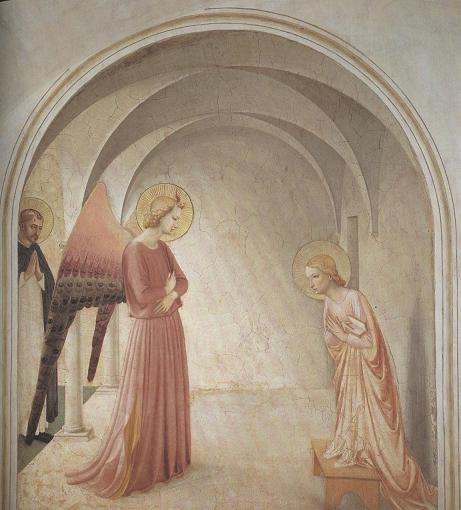
[2] On retrouve cette déférence dans les représentations picturales du frère dominicain Fra Angelico (1387 à 1395 ?-1455), où l’ange s’incline devant Marie. La seule exception que je connaisse se trouve dans la cellule n°3 du couvent de San Marco à Florence en Italie, où l’ange regarde Marie de haut et sans s’incliner.
Fresque de la cellule n°3 du couvent de San Marco |
Voir mon commentaire dans Les Annonciations de Fra Angelico op (1395-1455) - du texte à l’image
[3] Le monde invisible est mentionné au début du Credo de Nicée-Constantinople
[4] This article is based on a teaching given to the Rosary Teams of the Diocese of Amiens on 4 December 2025
[5] This deference is reflected in the paintings by the Dominican friar Fra Angelico (1387 to 1395 ?–1455), in which the angel bows before Mary. The only exception I am aware of is in cell no. 3 of the Convent of San Marco in Florence, Italy, where the angel looks down on Mary without bowing.
|
Fresco from cell no. 3 of the Convent of San Marco |
See my comment in Les Annonciations de Fra Angelico op (1395-1455) - du texte à l’image
[6] The invisible world is mentioned at the beginning of the Nicene-Constantinopolitan Creed
[7] この記事は、2025年12月4日にアミアン教区の ロザリオ・チーム に対して行われた教えに基づいています
[8] この敬意は、ドミニコ会の修道士フラ・アンジェリコ(1387年から1395年?–1455年)の絵画にも反映されており、そこでは天使がマリアの前に頭を下げている。私が知る唯一の例外は、イタリア・フィレンツェのサン・マルコ修道院の第3号室にあり、そこでは天使が頭を下げることなくマリアを見下ろしている。
|
サン・マルコ修道院第3号室のフレスコ画 |
Les Annonciations de Fra Angelico op (1395-1455) - du texte à l’image の私のコメントを参照
[9] 目に見えない世界については、ニカイア・コンスタンティノポリス信条の冒頭で言及されている
