S2-H12. La géhenne, un lieu effroyable ? ゲヘナとは、恐ろしい場所なのか? Is Gehenna a terrifying place ?
popularité : 13%

This article is part of the following series : "The Big Picture - La grande image - Season 2"
この記事は以下のシリーズの一部です : "The Big Picture - La grande image - シーズン2"
YouTube : https://youtu.be/GpKtcUG5pKw
Vous appréciez la présence de notre site sur le Web : vous pouvez faire un don à la communauté dans laquelle je vis (cliquer ici pour voir comment procéder)
Voir la liste des prédications - See the list of our preachings
Voir Évangile de Luc 12,1-7 - ルカによる福音書/ 12章 1 節~7 節をご覧ください - See Gospel by Luke 12:1-7
| Dans l’évangile d’aujourd’hui [1], Jésus demande à ses disciples de ne pas avoir peur de de la mort corporelle. De fait, les disciples connaîtront le sort de leur maître qui sera torturé avant de connaître la mort lente de la crucifixion. | 今日の福音 [2]において、イエスは弟子たちに、肉体の死を恐れてはならないと告げられます。実際、弟子たちは、拷問を受けた後、十字架上の苦痛に満ちた死を遂げる師と同じ運命をたどることになるのです。 | In today’s Gospel [3], Jesus asks his disciples not to be afraid of physical death. Indeed, the disciples will suffer the same fate as their Master, who will be tortured before enduring the slow death of crucifixion. |
| Attention ! Jésus ne nie pas que la mort sous la torture soit une réalité effroyable. Il dit qu’il y a une mort encore plus effroyable : être « envoyé » si on suit le latin mittere, « jeté » si on suit le grec emballein, dans la géhenne. | 注意してください!イエスは、拷問による死が恐ろしい現実であることを否定していません。イエスは、それよりもさらに恐ろしい死があるとおっしゃっています。それは、ゲヘナに「送られる」こと――ラテン語のmittereに従うならば――あるいは「投げ込まれる」こと――ギリシャ語のemballeinに従うならば――です。 | Take note ! Jesus does not deny that death by torture is a dreadful reality. He says that there is an even more dreadful death : to be ‘sent’ – if we follow the Latin mittere – or ‘cast’ – if we follow the Greek emballein – into Gehenna. |
| Jésus utilise ici des mots humains – mais que pourrait-il utiliser d’autre ? - pour pointer vers une réalité au-delà des mots et qui dépasse en effroi tout ce qu’on peut imaginer. Regardons ce mot « géhenne ». | イエスはここで人間の言葉を用いています――しかし、他に何を使えるというのでしょうか――言葉を超えた現実、すなわち私たちの想像をはるかに超える恐怖を指し示すために。ここで「ゲヘナ」という言葉について考えてみましょう。 | Jesus uses human words here – but what else could he use ? – to point to a reality beyond words, one whose horror surpasses anything we can imagine. Let us consider the word ‘Gehenna’. |
| La géhenne [4] est une vallée au sud de Jérusalem, un endroit maudit où avaient eu lieu des sacrifices humains. C’était là qu’on brûlait les ordures. | ゲヘナ [5] は、エルサレムの南にある谷であり、人身御供が行われていた呪われた場所です。そこではゴミが焼却されていました。 | Gehenna [6] is a valley south of Jerusalem, a cursed place where human sacrifices had taken place. It was there that rubbish was burnt. |
| Personnellement, mon oreille française entend le mot « haine » dans le mot « géhenne » : l’enfer serait le lieu de la haine, une haine à l’état pur, comme le paradis serait le lieu de l’amour à l’état pur. | 個人的には、フランス人の耳には、「ゲヘナ(géhenne)」という言葉は、「haine」「憎しみ」のように聞こえます。地獄とは憎しみの場所、最も純粋な形の憎しみの場所であり、それと同じように、楽園とは最も純粋な形の愛の場所であると言えるでしょう。 | Personally, to my French ear, the word ‘Gehenna’ sounds like ‘haine’ ‘hate’ : hell would be the place of hatred, hatred in its purest form, just as paradise would be the place of love in its purest form. |
| L’amour est un soleil qui réchauffe l’âme, qui la dilate, qui l’ouvre à la communion avec toute la création, visible et invisible, dans la reconnaissance et la louange en présence de Dieu - et c’est le plus grand bonheur qui soit. | 愛とは、魂を温め、それを広げ、目に見えるものも見えないものも含むすべての被造物との交わりへと魂を開き、神の御前で感謝と賛美を捧げる太陽のようなものです――それこそが、この世で最も大きな幸福なのです。 | Love is a sun that warms the soul, expands it, and opens it up to communion with all creation, visible and invisible, in gratitude and praise in the presence of God – and that is the greatest happiness there is. |
| Inversement, la haine serait comme une flamme noire qui recroqueville l’âme, qui la racornit, qui la replie sur elle-même, qui l’enferme dans le refus obstiné de Dieu, qui la fait se jeter sur ses compagnons pour les déchirer et qui se repaît de les voir partager avec elle le plus grand malheur qui soit : ne pas pouvoir se tenir devant Dieu – et ce serait cela la mort de l’âme. | 逆に、憎しみとは、魂を萎縮させ、枯れさせ、内向きに閉じ込め、神への頑なな拒絶の中に囚われさせ、他者に向かって牙を剥き、彼らを引き裂くように駆り立て、そして、彼らに「神の御前に立つことのできない」というこの世で最も大きな不幸を分かち合うのを見て喜びを覚える、黒い炎のようなものだろう――そして、それこそが魂の死である。 | Conversely, hatred would be like a black flame that causes the soul to cower, that withers it, that turns it in on itself, that imprisons it in a stubborn rejection of God, that drives it to lash out at its fellow beings to tear them apart, and that revels in seeing them share with it the greatest misfortune there is : not being able to stand before God – and that would be the death of the soul. |
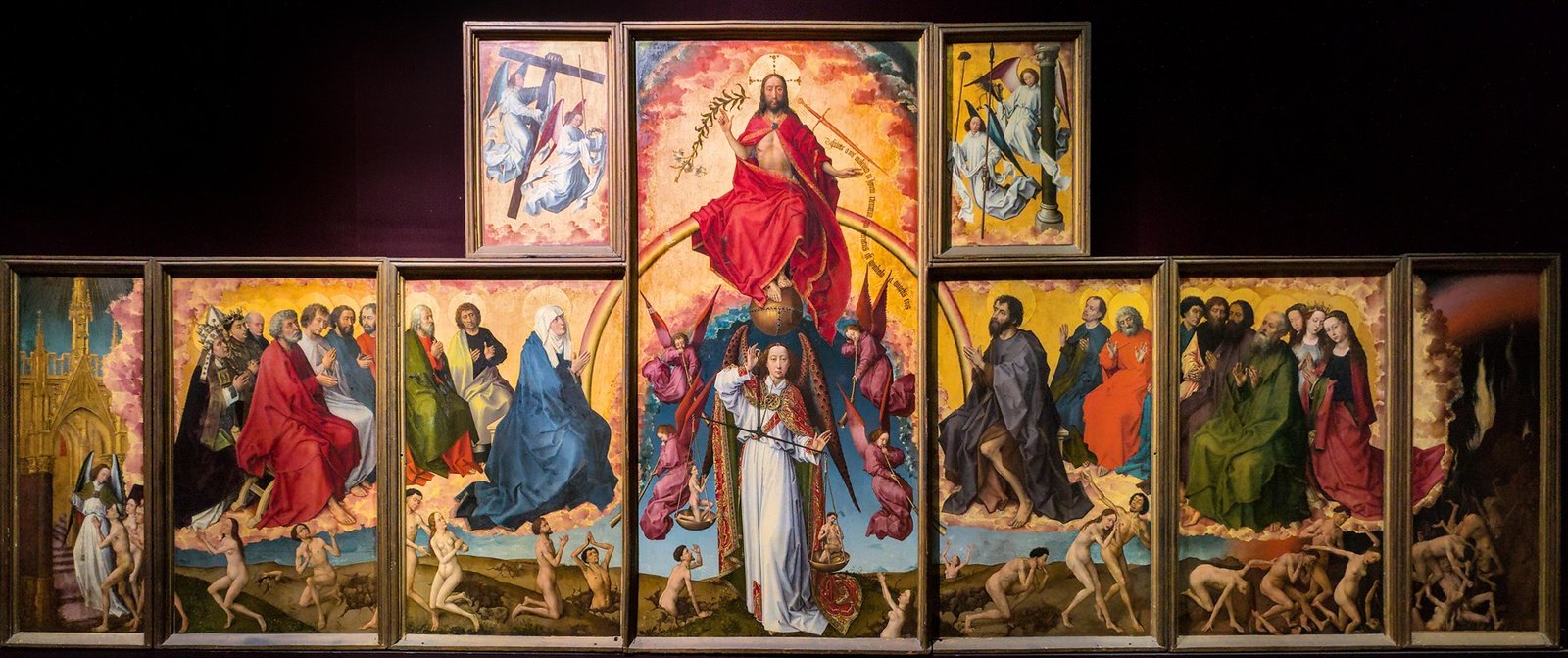
| Cette intuition de l’enfer est née pour moi en regardant le retable du Jugement dernier de l’Hospice de Beaune (1443-1452) par Roger van der Weyden – Rogier de la Pasture en français. Certains damnés se dirigent d’eux-mêmes vers la fosse sinistre, mais d’autres y sont entraînés de force, non par des démons mais par d’autres damnés. Et sur leur visage se lit l’expression de la folie et de la haine. | この地獄に関する洞察は、ロジェ・ファン・デル・ウェイデン――フランス語名ではロジェ・ド・ラ・パストゥール――による、ホスピス・ド・ボーヌ(1443–1452)の『最後の審判』の祭壇画を眺めている最中に、私に浮かんだものである。呪われた者たちの中には、自らの意思で不気味な深淵へと向かう者もいれば、悪魔ではなく他の呪われた魂たちに無理やり引きずり込まれる者もいる。そして、彼らの顔には狂気と憎悪の表情が浮かんでいる。 | This insight into hell came to me whilst looking at the altarpiece of the Last Judgement at the Hospice de Beaune (1443–1452) by Roger van der Weyden – Rogier de la Pasture in French. Some of the damned make their way of their own accord towards the sinister pit, but others are dragged there by force, not by demons but by other damned souls. And their faces bear an expression of madness and hatred. |
| À suivre cette image, l’enfer serait le lieu de la haine à l’état pur à laquelle communient humains et anges déchus, unis dans la même détestation universelle de Dieu, des autres et de soi. | この絵を信じるならば、地獄とは人間と堕天使が共有する純粋な憎悪の場であり、神、他者、そして自分自身に対する同じ普遍的な嫌悪感によって結ばれた場所となるだろう。 | If we are to believe this image, hell would be a place of pure hatred shared by humans and fallen angels, united in the same universal loathing of God, of others and of themselves. |
| Je ne crois pas qu’il faille disqualifier la crainte qu’inspire cette représentation de l’enfer, car elle peut être une étape nécessaire pour certains, sinon pour beaucoup, dans leur chemin vers Dieu [7] | 私は、この地獄の描写が喚起する恐怖を軽視すべきではないと考える。なぜなら、多くの人々にとってではないにせよ、一部の人々にとっては、神へと向かう旅路において、それが必要な段階であるかもしれないからだ [8] | I do not believe we should dismiss the fear inspired by this depiction of hell, for it may be a necessary stage for some, if not for many, on their journey towards God [9] |
| Je dis bien une étape, qui doit être dépassée. En effet, contrairement à ce que peut laisser croire la symétrie entre paradis et enfer dans les représentations traditionnelles du Jugement dernier, il n’y a pas de commune mesure entre l’un et l’autre : la haine, comme tout mal, ne peut rien créer, elle ne peut que détruire, autrement dit elle a besoin d’un bien pour exister alors que le bien n’a pas besoin du mal pour exister. Le mal est ce parasite qui ne peut subsister sans son hôte, tandis que l’hôte peut vivre sans son parasite. | 私が言うのは、まさに「段階」であり、それは乗り越えなければならないものである。実際、伝統的な「最後の審判」の描写に見られる天国と地獄の対称性が示唆するところとは逆に、この二者は比較の対象にもならない。憎しみは、あらゆる悪と同様に、何も生み出すことはできず、破壊することしかできない。言い換えれば、憎しみは存在するために「善」を必要とするが、善は存在するために悪を必要としない。悪とは、宿主なしでは生きられない寄生虫のようなものであり、一方、宿主は寄生虫なしでも生きることができるのである。 | I do mean a stage, one that must be overcome. Indeed, contrary to what the symmetry between heaven and hell in traditional depictions of the Last Judgement might suggest, there is no comparison between the two : hatred, like all evil, can create nothing ; it can only destroy ; in other words, it needs good in order to exist, whereas good does not need evil to exist. Evil is that parasite which cannot survive without its host, whilst the host can live without its parasite. |
| Plus fondamentalement, la haine est la réponse négative de la créature à l’amour qui vient de Dieu : l’amour qui procède de l’ordre du Créateur et qui dépasse infiniment l’ordre du créé dont ressort la haine. Il ne peut à ce titre y avoir de commune mesure entre ces deux réalités. | より根本的には、憎しみとは、神から発する愛に対する被造物の否定的な反応である。その愛は、創造主の秩序から生じ、憎しみが生じる被造物の秩序を無限に超越している。したがって、これら二つの現実の間に共通の基盤などあり得ない。 | More fundamentally, hatred is the creature’s negative response to the love that comes from God : the love that proceeds from the order of the Creator and which infinitely transcends the order of creation from which hatred arises. As such, there can be no common ground between these two realities. |
| Entrer dans la compréhension de cette dissymétrie, c’est commencer à ne plus s’intéresser qu’à la partie gauche du retable - parce que c’est elle la plus intéressante – et même la seule intéressante. | この非対称性を理解し始めるということは、祭壇画の左側の部分だけに焦点を当て始めることである――なぜなら、それが最も興味深い部分であり、実際、唯一興味深い部分だからだ。 | To begin to understand this asymmetry is to start focusing solely on the left-hand side of the altarpiece – because it is the most interesting part – and indeed the only interesting one. |
© fr. Franck Guyen op, octobre 2026
ルカによる福音書/ 12章 1 節~7 節 |
Luc 12,1-7 |
Luke 12:1-7 |
| その間に、おびただしい群衆が、互に踏み合うほどに群がってきたが、イエスはまず弟子たちに語りはじめられた、「パリサイ人のパン種、すなわち彼らの偽善に気をつけなさい。 | 1 Là-dessus, comme la foule était assemblée par milliers, au point qu’on s’écrasait, il commença par dire à ses disciples : « Avant tout, gardez-vous du levain des Pharisiens, la fausseté. | In the mean time, when there were gathered together an innumerable multitude of people, insomuch that they trode one upon another, he began to say unto his disciples first of all, Beware ye of the leaven of the Pharisees, which is hypocrisy. |
| おおいかぶされたもので、現れてこないものはなく、隠れているもので、知られてこないものはない。 | 2 Rien n’est voilé qui ne sera dévoilé, rien n’est secret qui ne sera connu. | 2 For there is nothing covered, that shall not be revealed ; neither hid, that shall not be known. |
| だから、あなたがたが暗やみで言ったことは、なんでもみな明るみで聞かれ、密室で耳にささやいたことは、屋根の上で言いひろめられるであろう | 3 Parce que tout ce que vous avez dit dans l’ombre sera entendu au grand jour ; et ce que vous avez dit à l’oreille dans la cave sera proclamé sur les terrasses. | 3 Therefore whatsoever ye have spoken in darkness shall be heard in the light ; and that which ye have spoken in the ear in closets shall be proclaimed upon the housetops. |
| そこでわたしの友であるあなたがたに言うが、からだを殺しても、そのあとでそれ以上なにもできない者どもを恐れるな。 | 4 Je vous le dis à vous, mes amis : Ne craignez pas ceux qui tuent le corps et qui, après cela, ne peuvent rien faire de plus. | 4 And I say unto you my friends, Be not afraid of them that kill the body, and after that have no more that they can do. |
| 恐るべき者がだれであるか、教えてあげよう。殺したあとで、更に地獄に投げ込む権威のあるかたを恐れなさい。そうだ、あなたがたに言っておくが、そのかたを恐れなさい。 | 5 Je vais vous montrer qui vous devez craindre : craignez celui qui, après avoir tué, a le pouvoir de jeter dans la géhenne. Oui, je vous le déclare, c’est celui-là que vous devez craindre. | 5 But I will forewarn you whom ye shall fear : Fear him, which after he hath killed hath power to cast into hell ; yea, I say unto you, Fear him. |
| 五羽のすずめは二アサリオンで売られているではないか。しかも、その一羽も神のみまえで忘れられてはいない。 | 6 Est-ce que l’on ne vend pas cinq moineaux pour deux sous ? Pourtant pas un d’entre eux n’est oublié de Dieu. | 6 Are not five sparrows sold for two farthings, and not one of them is forgotten before God ? |
| その上、あなたがたの頭の毛までも、みな数えられている。恐れることはない。あなたがたは多くのすずめよりも、まさった者である。 | 7 Bien plus, même vos cheveux sont tous comptés. Soyez sans crainte, vous valez mieux que tous les moineaux. | 7 But even the very hairs of your head are all numbered. Fear not therefore : ye are of more value than many sparrows. |
[1] Vendredi 16 octobre 2026, 28e semaine du temps ordinaire, en la mémoire facultative de sainte Marguerite-Marie Alacoque, vierge, à l’origine de la dévotion au Sacré-Cœur de Jésus
[2] 2026年10月16日(金)、通常期第28週、聖マルガリータ・マリア・アラコック(処女、イエスの聖心への敬礼の創始者)の任意記念日
[3] Friday 16 October 2026, the 28th week in Ordinary Time, on the optional memorial of Saint Margaret Mary Alacoque, virgin, founder of the devotion to the Sacred Heart of Jesus
[4] d’après le Dictionnaire du Nouveau testament de Xavier Leon Dufour
[5] 『新約聖書辞典』(ザビエル・レオン・デュフール著)によると
[6] according to the Dictionnaire du Nouveau Testament by Xavier Leon Dufour
[7] « La sagesse commence avec la crainte du Seigneur » lit-on en Proverbe 9,10.
[8] 「知恵は主を畏れることから始まる」と、箴言9:10に記されている。
[9] ‘Wisdom begins with the fear of the Lord’, as we read in Proverbs 9:10.
